Introduction
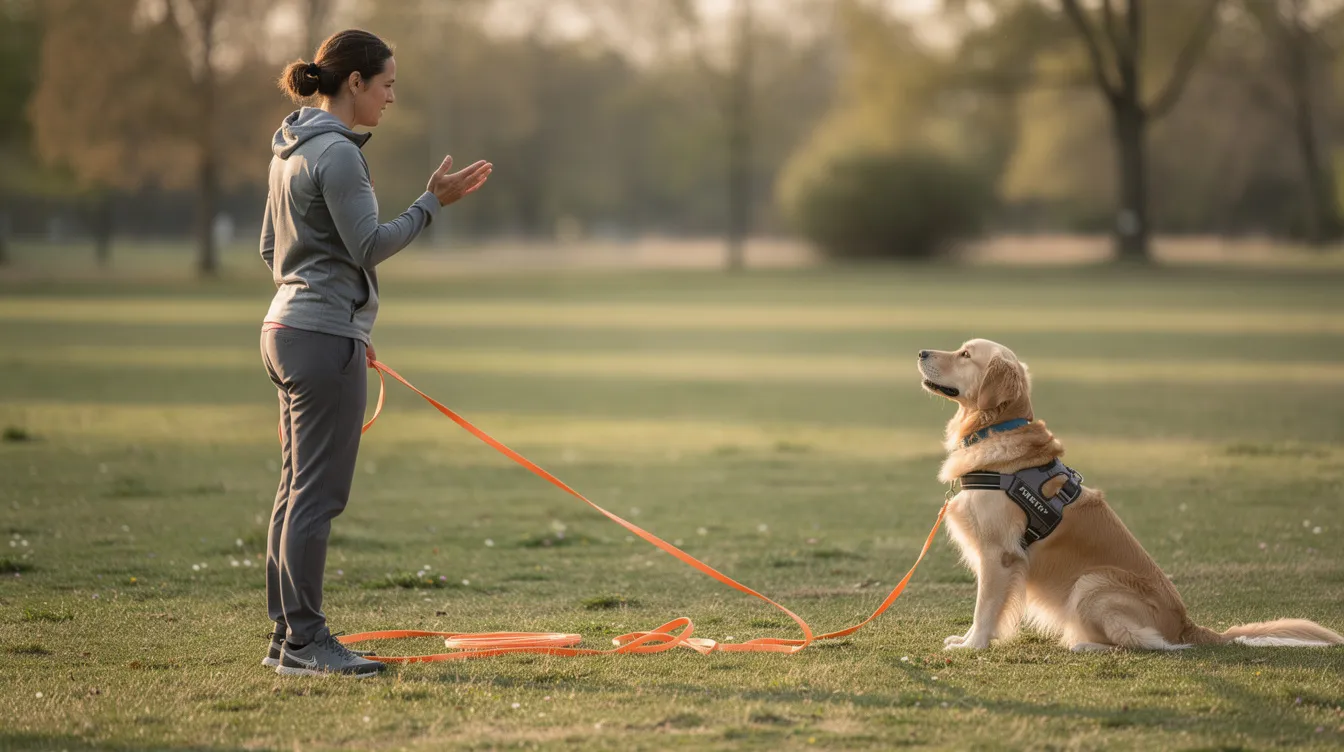
Long line training uses an extended leash, typically between 10 and 50 feet, to teach a dog reliable recall and distance commands while keeping the handler in control. A long line is a lightweight, durable leash made of fabric, nylon, or waterproof biothane. Unlike a standard leash or retractable leash, a long line has no spring mechanism and no constant tension; it simply trails behind the dog, providing a safety backup during recall training sessions.
This guide covers the equipment, methods, and staged progression behind long line training for dogs of all breeds and ages. It is written for dog owners who struggle with recall, leash pulling, or want distraction-proof obedience in real-world environments. Whether you have a puppy learning boundaries or an adult dog that bolts at full speed toward other dogs, this guide applies to your situation.
Long line training gives controlled freedom while ensuring safety. The goal is to bridge the gap between on-leash obedience and full off-leash reliability by gradually increasing distance and distractions until the dog’s recall holds without the line.
After reading this guide, you will understand how to:
- Select the right dog long line length, width, and material for your dog’s size
- Build a reliable recall using reward-based methods at increasing distances
- Achieve loose leash walking and reduce pulling behavior
- Proof obedience around distractions like other dogs, wildlife, and traffic
- Transition safely from long line work to off-leash control
Understanding Long Line Training Fundamentals
Long line training is a systematic approach to building off-leash behaviors while maintaining the dog’s safety through a physical backup. Long lines range from 3 to 30 meters in length, giving dogs more freedom to explore, sniff, and move at their own pace while the handler retains the ability to redirect or recall. Long line training helps improve a dog’s engagement with the handler because the dog learns that returning earns high-value rewards rather than the end of fun.
A dog that never practices recall at distance will not develop it. A tight leash keeps a dog close but teaches nothing about choosing to return. A long line can reduce constant tension that occurs on short leashes, allowing the dog to make decisions and experience consequences. UC Davis veterinary behaviorists recommend gradually increasing distance, distractions, and setting to build reliable recall; the long line is the tool that makes this progression possible without risking a lost dog.
Essential Equipment and Setup
Long lines typically measure between 10 and 50 feet in length. Start with a 5-meter long line for beginners; this length gives enough distance for initial recall practice without creating too much slack to manage. For serious recall training at range, a 30-foot line provides working room in an open field. Fifty-foot lines suit wide-open terrain but require practiced line management.
Long lines can be made from rope, fabric, or biothane materials, and each has distinct handling characteristics. A biothane long line is waterproof and easy to clean; standard 1-inch biothane has a published break strength around 1,000 pounds, and half-inch versions around 500 pounds. Nylon is lightweight and affordable but absorbs water, frays over time, and retains odor. Rope offers a soft hand feel but is heavier when wet and tangles more easily. Width should match dog size: 3/8-inch for a small dog under 20 pounds, 1/2 to 3/4-inch for dogs between 20 and 60 pounds, and 1-inch for large or strong dogs.
Using a harness for attaching a long line prevents neck strain in dogs. Attaching a drag line to a collar can injure a dog’s neck, particularly when the dog runs and hits the end of the line at speed. A back-clip harness distributes force across the chest rather than jerking the dog’s neck. Hardware matters too: the clip should be brass, steel, or aluminum alloy with a smooth swivel, and any handle loop should be reinforced with stitching or rivets.
Training Environment Considerations
Training recall begins in low-distraction, safe, open areas: a fenced yard, a quiet field, or an empty park. The dog needs to succeed repeatedly at short distances before the environment grows more challenging. Long line training encourages safe freedom for dogs to explore, but that freedom should match the dog’s current skill level.
As the dog masters recall in calm settings, you add layers: other dogs at a distance, foot traffic, wildlife scent along a trail. Proofing in multiple locations matters because a dog that recalls flawlessly in your backyard may ignore you at a busy park. Veterinary behaviorists recommend using the long line in each new location until obedience holds reliably before advancing. This staged approach prevents the dog from rehearsing bad behaviors like bolting or ignoring the recall cue.
With the right equipment and environment selected, the next step is applying specific training methods to different behavioral goals.
Long Line Training Methods and Applications
Using a long line is straightforward in concept but requires deliberate technique to build each target behavior. The three primary applications are recall at distance, distance command training, and leash pulling prevention.
Recall Training at Distance
Long lines allow dogs to practice recall in real-world distraction-heavy situations rather than only in sterile indoor environments. The line acts as a transitional tool before transitioning to off-leash training. A long line helps prevent rehearsing bad behaviors in dogs because the handler can prevent the dog from self-rewarding by running off.
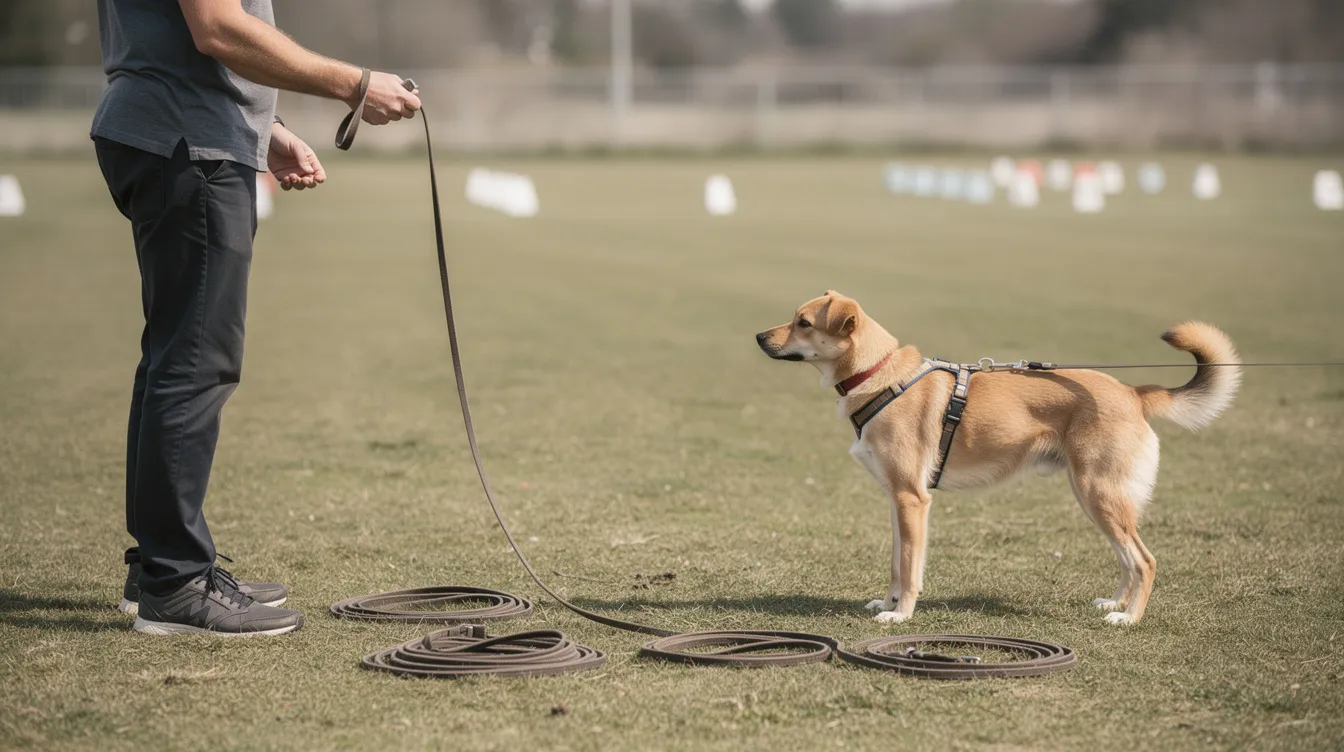
Begin with the dog at 10 to 15 feet. Call the recall cue once, clearly. When the dog moves toward you, reward immediately with high-value food or play. The reward must arrive the instant the dog checks in; delayed rewards weaken the association. Research comparing training methods found that dogs trained with reward-based recall had shorter latency (time from cue to first movement toward handler) and required fewer repeated commands than dogs trained with aversive tools.
Increase distance progressively: 15 feet, then 20, then 30, then full length. At each new distance, drop back to easier distractions. Long line training techniques include gradually increasing distance and distractions, but not both at the same time. If the dog runs toward a squirrel and the line prevents the chase, do not jerk the line; simply stop the dog’s forward motion, redirect, and reward the redirect. This teaches boundary awareness without sudden leash jerks.
Distance Command Training
Teaching sit, down, and stay at extended distances uses the long line as a backup. The dog learns that commands apply regardless of how far away the handler stands. Start with familiar commands at close range on the long line, then gradually add distance. If the dog breaks a stay at 20 feet, the line prevents departure while you calmly reset.
Toledo-area dog owners face specific distractions: deer along the Maumee River trails, geese in Wildwood Metropark, and off-leash dogs in unfenced areas. Training distance commands around these distractions requires the long line as a safety net. The line does not do the training; it prevents failure while reward-based methods build the behavior.
Leash Pulling Prevention
Long line training can improve leash manners and prevent pulling. On a normal leash, a dog that pulls gets constant feedback: a tight leash that the handler resists. This creates an opposition reflex where the dog pulls harder. A long line removes that cycle. The dog has slack, moves freely, and learns that walking near the handler produces good stuff (treats, praise, play) rather than tension.
Long lines teach dogs boundary awareness without sudden leash jerks. When the dog walks calmly with slack in the line, reward. When the dog moves ahead and creates tension, stop walking. The dog learns that a tight leash means the walk pauses, while loose leash walking means continued freedom. Over time, transfer this behavior to a standard 6-foot leash. The long line phase typically runs two to three weeks of daily practice before shortening to a normal leash produces the same calm walking behavior.
Step-by-Step Long Line Training Implementation
The methods above work best when applied in a structured sequence. Below is a phased protocol that moves from foundation skills through distraction-proof reliability.
Progressive Training Protocol
Each phase builds on the previous one. Move forward only when the dog’s recall succeeds on the first cue at least 80% of the time at the current level.
- Weeks 1-2: Foundation (low distraction, 5-15 feet). Work in a quiet fenced yard or empty field. Call recall 10 to 15 times per session, rewarding every success with high-value treats. Practice sit and down at a 10-foot distance. Let the line drag rather than holding it taut; grab it only if the dog ignores the cue. The dog learns that the line is present but not controlling. Keep sessions to 10 to 15 minutes; a dog that is bored or frustrated will tune out.
- Weeks 3-4: Moderate distractions and increased distance (20-30 feet). Move to a park or open area with moderate activity. Introduce other dogs at a distance, outdoor sounds, and varied terrain. Use a 30-foot line. Practice recall, sit, and stay with the added challenge. Reduce reward delay; the treat must appear within one second of the dog arriving. Long lines can be used as drag lines for safety during this phase, trailing behind the dog while you practice at distance.
- Weeks 5-6: High-distraction proofing (full length). Work near busy trails, dog parks (outside the fence), and areas with wildlife scent. Use the full line length. Begin trial off-lead moments with the long line dragging as backup; if the dog runs, step on the line or pick it up. This phase is where most owners see a dog’s recall jump from inconsistent to reliable. Track your success rate per session.
- Ongoing: Transition to off-lead reliability. Drop the line entirely in controlled areas. Return to the long line any time you enter a new environment or encounter a new distraction type. A long line acts as a transitional tool before transitioning to off-leash training; some dogs need it intermittently for months.
Training Method Comparison
| Method | Best For | Timeline | Reported Success Rate |
|---|---|---|---|
| Owner-led long line training | Basic recall, daily practice | 4-6 weeks | 70-80% first-cue recall |
| Professional board and train | Distraction-proof obedience | 2-3 weeks intensive | 90-95% first-cue recall |
| Owner-led maintenance after professional training | Long-term retention | Ongoing | Depends on consistency |
The difference between 70% and 95% recall is the difference between a dog that comes back most of the time and a dog you can trust near a road. Owner-led training works for many dog owners, but those with strong-drive dogs, reactive behavior, or limited training experience often see faster and more reliable results through a professional program followed by consistent home practice. One Toledo trainer reports that clients in 2-week board and train programs consistently achieve reliable recall, loose leash walking, and improved behavior in public settings with long line methods as the foundation.
Common Challenges and Solutions
Three problems account for most long line training frustrations. Each has a specific fix.
Dog Ignoring Recall Commands
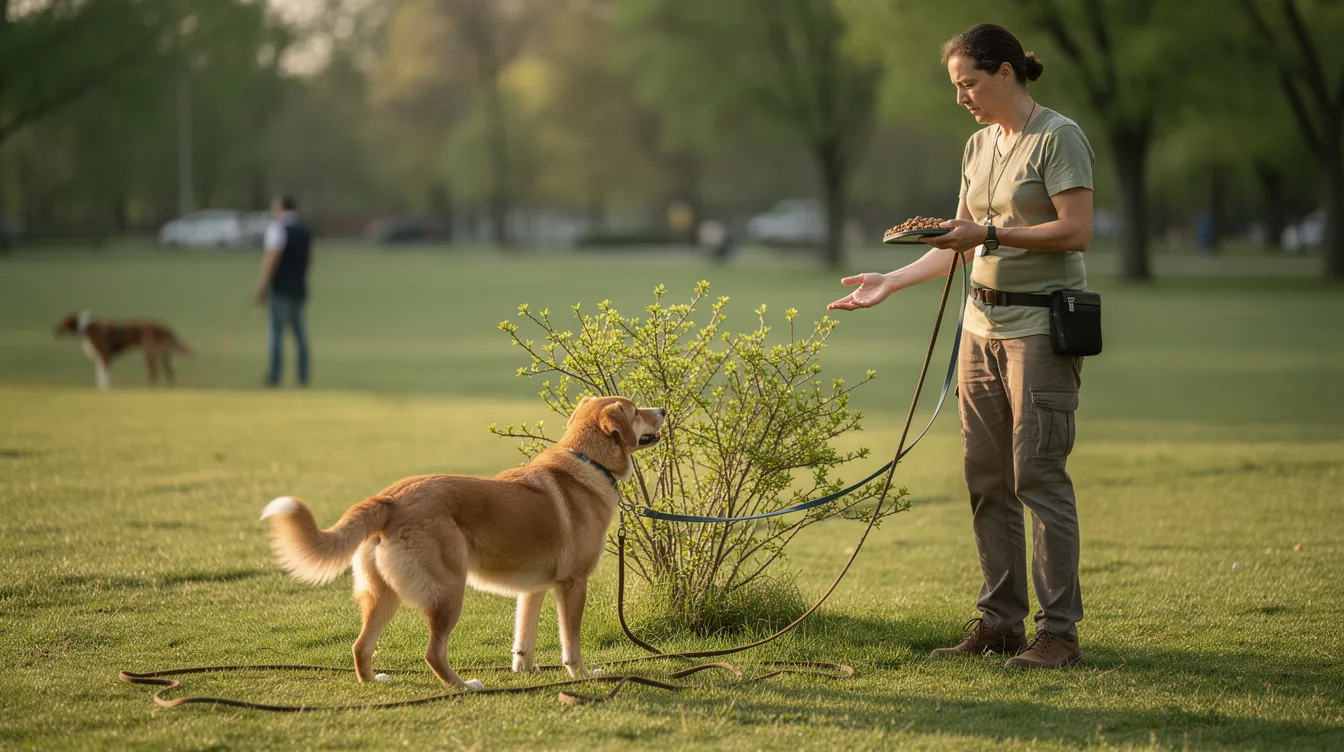
When a dog ignores recall, the environmental reward (chasing a squirrel, greeting another animal, nose work along a scent trail) outweighs the reward for returning. The fix is not to repeat the cue; calling a dog’s name five times teaches the dog that the first four calls are optional.
Instead, increase reward value. If you are using kibble, switch to real chicken or liver. If you are using food, add a game of tug. Reduce distractions back to the last level where recall worked, and rebuild from there. Use a long line to practice recall effectively so the dog cannot self-reward by ignoring you and continuing to run. If the problem persists after three weeks of consistent work, professional training can identify whether the issue is motivation, cue clarity, or an underlying behavioral problem.
Line Tangling and Safety Concerns
Long lines can tangle and cause serious injuries. Rope burns can occur with long lines if tangled around fingers, legs, or wrists. A dog that bolts at full speed can pull a trailing line across exposed skin and cause friction burns in under a second. Long lines can become trip hazards in busy environments, and managing slack on a long line helps prevent tangles and injuries.
Never wrap the line around your hand or fingers. Instead, gather slack in loose loops that release cleanly if the dog pulls. Wear gloves if you use rope or nylon. Choose a biothane long line for wet conditions; biothane long lines are waterproof and easy to clean, and their smooth surface reduces rope burn risk compared to braided rope. Watch for the line snagging on rocks, poles, or brush, and reposition if the trail or park has obstacles. Using a drag line can lead to developmental issues in puppies if the puppy catches a leg at an awkward angle, so supervise drag line sessions with young dogs at all times.
Inconsistent Results Around Distractions
A dog that recalls at home but ignores you at the park has not been proofed. The solution is systematic: list the specific distractions your dog struggles with (other dogs, joggers, bicycles, wildlife) and rank them from least to most exciting. Train recall in the presence of the least exciting distraction first, at a distance where the dog notices but does not fixate. Reward successful recalls. Gradually decrease distance to the distraction and increase the challenge level.
This process takes weeks, not days. A point many owners miss: if the dog fails twice in a row at a given distraction level, you have advanced too fast. Drop back to the previous level and spend more sessions there. Long line training builds a reliable recall in dogs, but reliability is built through hundreds of successful repetitions across dozens of environments, not through a single breakthrough session.
Conclusion and Next Steps
Long line training is the most reliable method for bridging on-lead obedience to off-lead control. The long line gives a dog safe freedom of movement while preventing the self-rewarding behaviors that undermine recall. The progression from short distances in quiet spaces to full-length work in high-distraction environments follows a clear, repeatable protocol that applies to dogs of any breed, age, or size.
To start:
- Select a line length and material matched to your dog (5-meter biothane for beginners; 30-foot for intermediate recall work)
- Attach to a back-clip harness, not a collar
- Begin in a low-distraction environment and practice 10 to 15 recall repetitions per session
- Track your success rate and advance only when first-cue recall exceeds 80%
- Proof across multiple locations and distraction types before attempting off-lead work
For dog owners in the Toledo area seeking faster results or dealing with reactive behavior, Off Leash K9 Training Toledo’s board and train programs compress the long line training timeline into two to three weeks of intensive work and include owner education for long-term maintenance. Understanding what age to begin training and how to select appropriate training equipment can also support your long line training program.
The long-term outcome of consistent long line work is a dog you can trust in the park, on the trail, and in daily life; a dog that comes when called because returning to you is the best option available.