Bringing home a puppy means introducing them to unfamiliar people, sounds, surfaces, animals, objects, and routines. A puppy socialization checklist helps you organize those experiences without rushing your puppy or turning every outing into an overwhelming event.
Socialization does not mean your puppy must greet every person or play with every dog. The goal is to help your puppy notice new experiences, remain within a manageable comfort level, and build positive or neutral associations over time.
Use this checklist as a flexible guide. Adjust each activity to your puppy’s age, health, vaccination status, temperament, and body language. Ask your veterinarian which environments and animal interactions are appropriate.
Key Takeaways
- Keep sessions short, controlled, and positive.
- Let your puppy observe without forcing interaction.
- Introduce new experiences gradually.
- Use rewards and distance to support calm behavior.
- Stop before your puppy becomes overwhelmed.
- Ask your veterinarian about local disease risks.
What Puppy Socialization Really Means
Puppy socialization is broader than meeting people and dogs. Socialization also includes safe exposure to handling, grooming, vehicles, household sounds, surfaces, new rooms, and calm independence.
A successful exposure does not require direct contact. Watching a bicycle, hearing a vacuum from another room, or observing a calm dog can all be useful.
The American Veterinary Medical Association identifies approximately 3 to 14 weeks as an important socialization period. Because many puppies have not completed their vaccines, avoid sick animals, dogs with unknown vaccination histories, and environments your veterinarian considers high risk.
Review the AVMA’s guidance on socialization for dogs and cats and discuss local risks with your veterinarian.
How to Use This Puppy Socialization Checklist
Treat this list as a tracking tool, not a deadline. Your puppy does not need to experience everything in one week.
For each exposure, note the date, location, distance, your puppy’s response, the reward used, and whether it should be repeated.
Begin far enough away that your puppy can still take treats, respond to their name, and move comfortably. Increase the difficulty only when your puppy appears relaxed and recovers quickly. A brief, calm experience is usually more useful than a long, overwhelming outing.
People and Appearance Checklist
Help your puppy become comfortable seeing people with different appearances, movements, voices, and clothing. Not every person needs to touch or approach your puppy.
- Adult men, women, teenagers, and older adults
- Calm children under close supervision
- People with facial hair
- People wearing hats, sunglasses, hoods, or bulky coats
- People carrying packages or using umbrellas
- People wearing uniforms
- People using canes, walkers, or wheelchairs
- Visitors and delivery workers viewed safely
- People speaking, laughing, or moving differently
Allow your puppy to choose whether to approach. Calm observation without direct interaction still counts as useful socialization.
Handling, Grooming, and Veterinary Care Checklist
Gentle handling can prepare your puppy for grooming, nail care, veterinary exams, and daily routines. Keep each session brief and pair handling with small rewards.
- Touching and looking inside the ears
- Touching paws, nails, teeth, and gums
- Touching the collar and using a harness
- Gentle brushing and towel wiping
- Touching the tail, stomach, and sides
- Standing on a nonslip mat
- A brief veterinary-style body check
- Hearing grooming tools from a distance
- Entering a crate or carrier calmly
Stop when your puppy repeatedly pulls away, hides, stiffens, or becomes increasingly mouthy. Handling practice should never involve pinning a frightened puppy down.
Sounds, Movement, Surfaces, and Objects
Start louder sounds at a low volume or from another room. Reward calm observation and avoid intentionally startling your puppy.
Household sounds may include doorbells, knocking, televisions, phone alerts, vacuums, appliances, hair dryers, doors, keys, children, visitors, and running water.
Outdoor experiences may include cars, trucks, motorcycles, bicycles, skateboards, garbage trucks, lawn equipment, construction, distant sirens, barking dogs, wind, rain, and moving decorations.
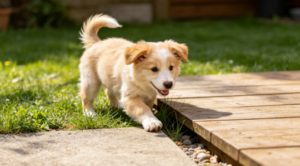
Surfaces and objects may include carpet, tile, wood, concrete, grass, gravel, wet pavement, rubber mats, ramps, stairs, sidewalk grates, automatic doors, shopping carts, umbrellas, boxes, and yard decorations.
Let your puppy investigate voluntarily. Do not pull them toward a sound, object, or surface they fear.
Dogs and Other Animals Checklist
Socialization with animals should be controlled. Crowded dog parks and uncontrolled greetings are not required for healthy puppy development.
Useful experiences may include a calm adult dog, a suitable puppy, small and large dogs, dogs viewed without greeting, a calm dog nearby, a cat behind a barrier, and other animals viewed safely from a distance.
Choose dogs with known health and behavior histories. Supervise direct interactions and provide breaks when either dog becomes overwhelmed, repeatedly tries to escape, or cannot settle.
Socialization also includes learning to ignore other animals and return attention to the owner.
Places and Environments Checklist
Build from familiar, quiet environments toward more active locations. Choose places your veterinarian considers appropriate for your puppy’s health and vaccination status.
Possible locations include front and back yards, quiet sidewalks, residential streets, parked cars, short car rides, veterinary or grooming offices, quiet parking lots, calm pet-friendly stores, parks, friends’ homes, new rooms, covered porches, and busier places observed from a distance.
For Toledo puppies, seasonal exposure may include wet sidewalks, wind, snow, heavy coats, snow-removal equipment, and louder indoor environments during colder months. Introduce each experience gradually.
Puppy Socialization Before Vaccinations Are Complete
Early socialization and disease prevention both matter. The safest plan depends on your puppy’s age, health, vaccine history, and local disease risk.
Ask your veterinarian about appropriate puppy classes, contact with known, healthy, appropriately vaccinated dogs, clean private yards, being carried in public, observing activity from a vehicle, and visiting controlled indoor environments. Also ask whether your puppy should avoid shared water bowls and areas heavily used by dogs with unknown health histories.
At home, you can still introduce handling, sounds, surfaces, visitors, crates, short alone-time exercises, and household objects.
Do not assume that socializing a puppy requires placing an unvaccinated puppy on the ground in a busy public area. Your veterinarian can help you balance early learning with health precautions.
Signs Your Puppy Is Comfortable or Overwhelmed
A comfortable puppy may explore, take treats, display a loose body, return attention to you, and recover quickly.
Reduce the intensity when your puppy freezes, hides, tries to escape, tucks the tail, refuses treats, repeatedly barks or growls, becomes frantic, or cannot recover.
Growling, barking, hiding, and hesitation provide information about how your puppy feels. Punishing those warning signs does not make the situation safer.
When your puppy becomes nervous:
- Increase the distance.
- Lower the volume or intensity.
- Stop direct interaction.
- Let your puppy observe.
- Offer a reward without forcing movement.
- End the session if your puppy cannot settle.
- Try again later at an easier level.
Common Puppy Socialization Mistakes
Avoid forcing greetings, completing the checklist too quickly, treating dog parks as essential, letting everyone touch the puppy, ignoring body language, punishing fear, or encouraging constant excitement.
A well-socialized puppy does not need to become highly excited around every person or dog. Calmness, neutrality, and the ability to focus on the owner are valuable goals.
How to Track Puppy Socialization Progress
Keep a simple record of each experience, including the date, your puppy’s response, the reward used, and whether the activity should be repeated.
Track experiences such as unusual clothing, household sounds, car rides, calm dogs, veterinary handling, new surfaces, and quiet public places. Notes may include relaxed, curious, recovered, needed more distance, refused treats, or repeat at a lower intensity.
When Professional Puppy Training Can Help
The Puppy Training Consultation covers puppy socialization, confidence building, environmental desensitization, potty training, basic commands, and other common puppy questions.
Owners who need one-on-one guidance can explore private dog training or foundational dog obedience training.
If fear, anxiety, or reactivity becomes more serious as a dog develops, the team can discuss whether dog aggression training is appropriate. These concerns depend on the individual dog, and training should not be viewed as a promise that aggression, anxiety, or reactivity will be completely eliminated.
Dogs six months or older may qualify for the 2-Week Board & Train program, which focuses on practical obedience and is not designed for dogs with behavioral issues. Dogs needing training for anxiety, aggression, or behavior modification do not qualify for the 1-Week Freedom Board & Train. Review current eligibility requirements on the Plans & Pricing page.
Final Thoughts
A puppy socialization checklist gives you a practical way to organize new experiences, but it should never become a race. The goal is to help your puppy observe, recover, and build confidence gradually.
Keep sessions short, allow space, use appropriate rewards, and ask your veterinarian about safe exposure before vaccinations are complete.
For help creating an age-appropriate plan, contact Off Leash K9 Training Toledo or call (419) 441-4023 to schedule a free phone consultation.
Frequently Asked Questions
What should be included in a puppy socialization checklist?
Include controlled exposure to people, handling, household and outdoor sounds, surfaces, moving objects, animals, car rides, veterinary care, and new environments.
How many new experiences should my puppy have each day?
There is no required number. A few brief, positive experiences are more useful than a long list that overwhelms your puppy.
Can I socialize my puppy before vaccinations are complete?
Often, yes, but your veterinarian should approve the type of exposure based on your puppy’s age, health, vaccination history, and local disease risk.
Does socialization mean my puppy should meet every dog?
No. Puppies also need to learn how to observe and pass other dogs calmly. Direct interaction should be limited to suitable dogs in controlled conditions.
When should I contact a puppy trainer?
Consider professional guidance when your puppy repeatedly freezes, hides, growls, barks, tries to escape, refuses food, or cannot recover during common experiences. Sudden behavior changes or possible signs of pain should first be discussed with a veterinarian.