Introduction
Resource guarding occurs when a dog defends an item they value, whether food, toys, or even humans, using behaviors ranging from a subtle freeze to a full bite. About 15% of dogs evaluated in a large US shelter study (Tompkins SPCA, 161 out of 1,051 dogs) displayed resource guarding behavior, making it one of the most common behavioral concerns dog owners face.
This guide covers how to identify guarding in dogs at every stage, from the first body stiffening to escalated aggression. It walks through prevention strategies, positive reinforcement training protocols, environmental management, and the specific conditions that call for a veterinary behaviorist or certified trainer. The information applies to puppy owners building good habits, families managing an adult dog that has shown signs of guarding, and multi-pet households in the Toledo area looking for local professional support.
Resource guarding can be managed and reduced through structured training methods (trade-ups, “drop it” cues, counter-conditioning), consistent environmental management, and professional guidance for cases involving bites or generalized aggression.
After reading, you will be able to:
- Recognize early and escalated signs of resource guarding through dog body language
- Understand the root causes, including anxiety, past scarcity, and genetic component factors
- Implement a step-by-step positive reinforcement training protocol at home
- Create a management plan tailored to your household, including families with children or other dogs
- Determine when to seek professional help and how to find qualified trainers in Toledo, Ohio
Understanding Resource Guarding Behavior
Resource guarding is an instinctive survival behavior. Wild animals that protected access to food, shelter, and mates were more likely to survive and reproduce. Domestic dogs retain these hardwired responses, but in a modern dog home where food arrives in a bowl twice a day and bones sit in a basket by the couch, the mismatch between ancestral scarcity and present abundance can turn a natural impulse into a household safety problem.
Normal vs. Problematic Guarding
Not every guarding response requires intervention. A dog that picks up a bully stick and walks to another room, or stiffens briefly when another dog approaches during eating, is displaying mild, expected behavior. Many dogs do this without ever escalating. In shelter data, roughly 83% of dogs classified as resource guarders fell into the mild-to-moderate range (stiffening, freezing, low growling), while about 17% escalated to snapping or biting.
Problematic guarding looks different. A dog that lunges at a family member reaching near its food bowl, snaps when a child walks past its resting spot, or begins guarding new items and spaces it previously ignored has crossed into territory that poses real risk. Resource guarding exists on a spectrum from subtle to overt aggression, and recognizing where your dog falls on that spectrum determines the response.
Root Causes and Triggers
Resource guarding often stems from anxiety in dogs. A dog that feels uncertain about whether it will keep access to something valuable defaults to defensive behavior. Former street dogs may guard food due to past scarcity; puppies can start resource guarding as they compete for food with littermates, carrying that learned competition into their new homes.
Owner behavior plays a direct role. Taking items away from dogs can worsen guarding behavior because each removal confirms the dog’s fear that resources disappear when humans approach. Force-based training methods often worsen resource guarding behavior by layering fear on top of existing anxiety. Misguided training, such as repeatedly reaching into a food bowl to “teach” a dog to tolerate it, can reinforce resource guarding behaviors rather than resolve them.
Triggers for resource guarding can include food, toys, and resting spots, but also people, locations, and even trash can contents a dog has scavenged. Identifying specific triggers is crucial for managing resource guarding, and that identification begins with reading your dog’s body language.
Recognizing Resource Guarding Signs
Understanding what causes guarding behavior makes it easier to spot. The challenge is that early signs are quiet. A dog that freezes for half a second over its food bowl gives you a window to intervene with training before the behavior reaches growling or biting.
Early Warning Signals
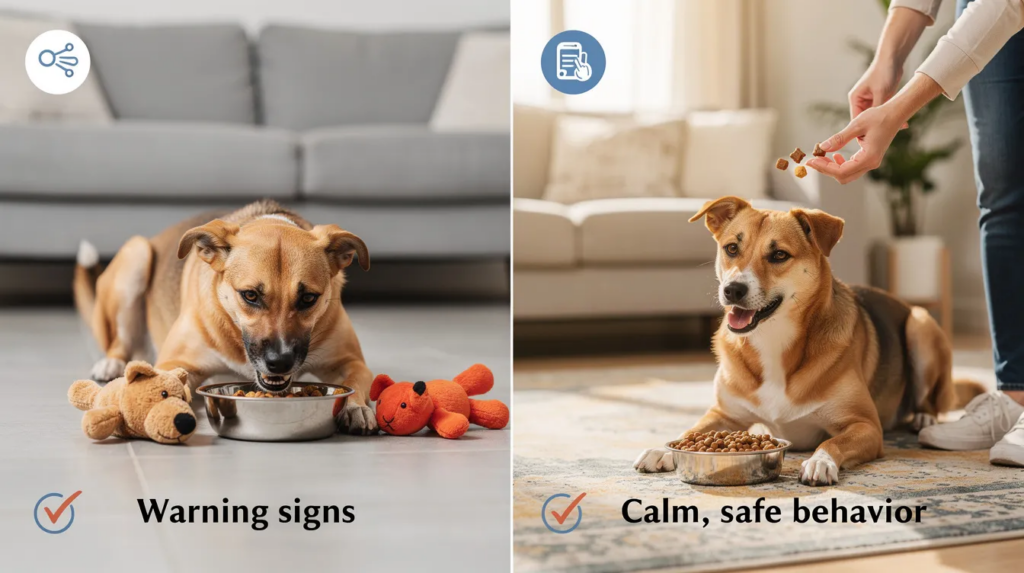
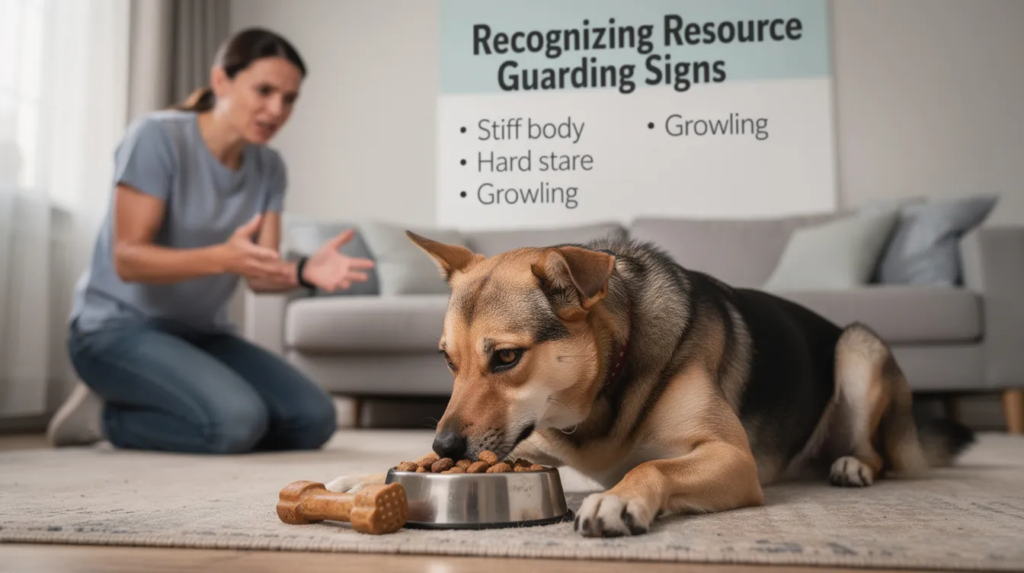
Subtle signs of resource guarding include freezing or body blocking. When a dog stiffens its entire body as you approach its food, or positions itself between you and a toy, it is communicating discomfort. Other early indicators:
- Whale eye: the dog turns its head but keeps its eyes fixed on the approaching person, showing the whites of its eyes
- Rapid ingestion: the dog speeds up eating, swallowing food without chewing, as if racing to finish before the resource is taken
- Hovering or covering: the dog lowers its head and body over the item, shielding it spatially
- Carrying and retreating: the dog leaves the room with the item rather than staying to enjoy it
These behaviors are easy to miss. A puppy that eats faster when you walk by the food bowl is already showing a guarding pattern. Notice these signals early, and you have far more options for training.
Escalation Behaviors
When early warnings go unaddressed, or when owners respond by forcibly taking items from a dog (which can increase fear and aggression), the behavior escalates. Overt warning signs include hard stares and vocalizations like growling. Resource guarding can manifest as avoidance or aggressive behaviors; some dogs flee with the item while others stand their ground.
The escalation typically follows a progression: freeze, then growl, then snarl with teeth visible, then snap, then bite. Never punish a dog for growling as it is an important communication tool. A dog that has been punished for growling may skip the warning entirely and go straight to a bite.
Dogs may also expand their guarding. One dog might start by guarding only its food bowl, then begin to guard toys, then its crate, then a favorite person. In a study of companion dogs with guarding behavior, researchers observed this pattern of generalization across resources and contexts.
Different Types of Resources
Food and food related items are the most commonly guarded resources. This includes the food bowl during meals, bones, treats, and scraps found on a walk. Food guarding can escalate to aggressive behavior if a dog perceives repeated threats to its meals. Feeding in a quiet area helps to prevent resource guarding behaviors, particularly in busy households.
Toys and objects trigger guarding in a different context. Dogs that guard toys often do so when a person reaches for the item. A dog with a bully stick or a stolen sock may show no guarding at rest but stiffen or growl the moment a hand extends toward the object.
Beds, resting places, and locations represent spatial guarding. A dog may growl when a family member approaches while it is lying on the couch or in its crate. This type of guarding is less studied but consistently reported by owners.
People guarding creates unique challenges in family settings, especially with children. Some dogs become possessive of a favorite human, displaying aggressive behaviors when other animals or certain people approach. This form of guarding is particularly dangerous in homes with young children who move unpredictably.
With these recognition skills in place, the next step is building a structured training and management plan.
Professional Training and Management Strategies
Knowing what you are looking at is the foundation. Changing the behavior requires a systematic approach that combines positive reinforcement training with environmental management. Research from Queen’s University Belfast demonstrated that functional behavior assessment combined with backward chaining reduced both frequency and intensity of aggressive guarding in companion dogs.
Step-by-Step Training Protocol
This protocol works for mild-to-moderate guarding cases. For dogs that have bitten or snap at low thresholds, skip to the professional help section below.
- Assess and list triggers. Write down every item, location, and context where your dog has shown signs of guarding. Also note items the dog does not guard. This list guides the entire training plan.
- Identify high-value rewards. Find tasty treats that outrank whatever your dog guards. If your dog guards kibble, use hot dogs or cheese. If your dog guards a bully stick, find a special treat that makes the dog willingly drop things. Reserve these treats exclusively for guarding training.
- Teach “drop it” with non-guarded items. Start with objects the dog does not care about. Present the object, let the dog hold it, say “drop it,” and immediately offer the high-value treat. Repeat until the dog reliably drops the item on cue. Teaching a strong “drop it” cue can reduce resource guarding. Hand feeding puppies can prevent future resource guarding behavior; if you are starting with a pup, build these habits from day one.
- Introduce the trade-up method for guarded items. Once “drop it” is solid with neutral objects, begin with lightly guarded items. Present the guarded item, offer a higher-value treat, and reward the release. Teaching a positive trade can help reduce resource guarding behaviors. The dog learns that giving something up produces something better.
- Practice graduated approaches near resources. While the dog is eating from its food bowl, stand at a distance where the dog can remain relaxed. Toss a treat toward the bowl and step back. Over sessions (days to weeks), gradually decrease distance. Counter-conditioning is used to change a dog’s emotional response to triggers; you are teaching the dog that a person approaching during meals means bonus food, not theft.
- Generalize across people, locations, and items. Practice with different family members, in different rooms, and with different resources. A dog trained to drop a toy in the kitchen but never in the yard has not generalized the behavior. Use different locations, different handlers, and gradually add distractions.
- Maintain safety throughout. Use baby gates to separate the dog during high-risk moments. Never reach into a food bowl until the dog shows relaxed body language at close range. If the dog growls, you have moved too fast; increase distance and slow the progression.
Positive reinforcement training is essential for managing resource guarding. In a study of four companion dogs with object guarding, clicker training combined with backward chaining reduced category II stress responses (ears back, hovering) by 39-55% and category III responses (hard stare, stiffening) by 58-69%. Some regression occurred without ongoing practice, so consistency matters long-term.
Management vs. Training Approaches
Resource guarding behavior can be managed through environmental management and training, and most households need both. Here is how they compare:
| Criterion | Environmental Management | Behavior Modification Training |
| Timeline | Immediate implementation | Weeks to months of consistent work |
| What it changes | Prevents incidents by removing triggers | Changes the dog’s emotional response to triggers |
| Safety level | High; reduces risk by avoiding confrontation | Moderate during training; requires managed setups |
| Long-term outcome | Behavior persists if management stops | Can generalize if owner maintains consistency |
| Example | Feeding dogs in a separate room; picking up toys before guests arrive | Teaching “drop it,” trade-up exercises, graduated approaches |
Management alone does not teach the dog a new response. Training alone without managing triggers creates situations where the dog practices guarding between sessions. The combination works: manage the environment to prevent rehearsal of guarding while running structured training sessions to change the underlying behavior.
Providing ample resources helps reduce possessive behavior in dogs. If two dogs share one food bowl, competition is built into every meal. Separate feeding stations, multiple water bowls, and enough toys that no dog needs to compete reduces the daily pressure that fuels guarding.
For households exploring professional support, board and train programs provide an immersive environment where trainers can manage safety, supervise exposure, and work on generalization before the dog returns home.
Common Challenges and Solutions
Training Plateau or Regression
A dog that stopped growling over its food bowl for three weeks, then starts again, has not “failed.” The backward chaining study found that some deep guarding behaviors returned without maintenance practice. Review your consistency: Are all family members following the protocol? Has the value of your training treats dropped below the value of the guarded item? Has a new environmental factor (a visitor, a new pet, a change in routine) reintroduced anxiety? Adjust the treat value, reduce difficulty temporarily, and rebuild. If progress stalls for more than two weeks despite consistent effort, consult a qualified trainer.
Multiple Pet Households
When one dog guards food from other dogs, the non-guarding dog often learns to avoid, creating tension that surfaces in other contexts. Feed each dog in a separate room with doors closed. Pick up all high-value items (bones, bully sticks, stuffed chew toys) when dogs are together. Supervise play and introduce new dogs with structured protocols rather than free access. The ASPCA/Wisconsin study found that shelter dogs showing food guarding during assessments were almost all non-guarders in adopted homes by three months; environment matters as much as individual temperament.
Children and Resource Guarding Dogs
Children under age six are at the highest risk in households with guarding dogs. Kids approach quickly, reach for items without warning, and do not read dog body language. The solution has three layers:
- Supervision: No child should be near the dog during feeding or when the dog has a high-value item. Zero exceptions.
- Safe zones: The dog’s crate, bed, or designated room should be off-limits to children. Baby gates create physical barriers. Teaching a place command gives the dog a reliable retreat.
- Teaching children: Kids old enough to understand can learn never to approach a dog that is eating, to leave dropped items for an adult to retrieve, and to walk away calmly if a dog growls.
Professional help is crucial if your dog might bite someone. If your dog guards from children, seek a dog aggression trainer or veterinary behaviorist before attempting home training in that context.
When to Seek Professional Help
Seek professional help if resource guarding escalates to aggression. Specific situations that require expert involvement:
- The dog has bitten or snapped at a person over a guarded item, even without breaking skin
- Guarding is generalized across many resources, people, or pets
- The dog guards from children or vulnerable household members
- An underlying medical issue (pain, cognitive decline, dental problems) may be lowering the dog’s tolerance threshold; consult a veterinarian to rule this out
- You feel unsafe or uncertain during training attempts
A veterinary behaviorist (a veterinarian with board certification in behavior) can assess whether pharmacological support (such as SSRIs for anxiety) is appropriate alongside behavior modification. The Ohio State University Veterinary Medical Center maintains behavioral medicine resources that serve as a referral source for the Toledo area. Choose trainers who use positive reinforcement methods only; understanding the different types of trainers helps you find the right fit. Consult a veterinarian for trainer recommendations if needed.
Conclusion and Next Steps
Resource guarding is a common behavior in dogs with roots in survival instinct, shaped by anxiety, learning history, and environment. About 83% of guarding cases fall in the mild-to-moderate range, and these respond well to structured training: trade-ups, “drop it” cues, graduated approaches, and consistent environmental management. Dogs may guard toys, food, or even humans, but the underlying training principles remain the same across all resource types.
Start here:
- Assess your dog’s guarding triggers by listing every item, location, and context where you notice guarding behavior
- Implement immediate safety measures: separate feeding areas, baby gates, removal of high-value items during unsupervised time
- Begin “drop it” training with non-guarded items using high-value treats
- Progress to trade-up exercises with guarded items, moving at a pace where your dog can remain relaxed
- If your dog has bitten, guards from children, or shows generalized aggression, contact a professional trainer or veterinary behaviorist before proceeding with home training
For owners looking to build broader obedience foundations, private training sessions and puppy training programs establish the communication skills and impulse control that prevent guarding from developing in the first place.
Additional Resources
Training tools for safe resource guarding work: Treat pouch for quick reward delivery, clicker or verbal marker for precise timing, baby gates or exercise pens for barrier management, long leash or tether for controlled distance work, and a stable feeding station that reduces competition at mealtimes.
Emergency management for immediate safety: If a dog has a dangerous item (chicken bones, medication, sharp object) and has shown signs of guarding, do not reach for it. Drop a handful of high-value treats (hot dogs, cheese) on the floor several feet away. When the dog leaves the item, calmly remove it. If the dog does not leave, lure it to a separate room with treats, close the door, then retrieve the item.
Selecting qualified professionals in Toledo: Look for credentials from the IAABC (International Association of Animal Behavior Consultants) or CCPDT (Certification Council for Professional Dog Trainers). Veterinary behaviorists hold board certification through the American College of Veterinary Behaviorists. Ask any prospective trainer about their specific experience with aggression cases and confirm they use positive reinforcement rather than punishment-based methods.