Introduction
Yes, old dogs can absolutely learn new tricks. The tired proverb “you can’t teach an old dog new tricks” has been thoroughly debunked by modern canine research-senior dogs retain meaningful learning capacity well into their golden years, and with the right approach, they can master a few new tricks that keep their brain active and their tail wagging. Older dogs can learn new tricks at any age, and in many cases, their longer attention spans and calmer temperaments actually make them more focused students than their younger canine friends.
This guide covers everything pet owners need to know about training senior dogs aged 7 and older, including how cognitive and physical changes affect learning, which age-appropriate training methods work best, and how to set realistic expectations. We’ll focus exclusively on techniques tailored to mature dogs-excluding the puppy training basics you’ll find elsewhere-and address the practical challenges of working with dogs experiencing the natural aging process.
The core answer is straightforward: senior dogs retain the ability to learn throughout their lives, though training approaches need age-appropriate modifications to account for changes in mobility, sensory perception, and stamina. Older dogs can learn new tricks with patience, the right tricks, and consistent positive reinforcement.
Here’s what you’ll take away from this guide:
- How senior dog cognition works: What changes with age and what remains sharp
- Effective training techniques: Methods designed specifically for older dogs’ needs
- Age-appropriate trick ideas: Simple tricks and less strenuous tricks that provide enrichment without strain
- Overcoming physical limitations: Adapting training for creaky joints, hearing deficit, and vision changes
- Building stronger bonds: How training sessions with mature dogs enjoy bonding and improve quality of life
Understanding Senior Dog Learning Capacity
The old dog new tricks myth persists despite substantial scientific evidence to the contrary. Research from the Clever Dog Lab at the Messerli Institute involving 119 pet dogs confirmed that while measures like attentiveness and memory do decline with age, older dogs remained fully capable of learning entirely new tasks when properly motivated. Dogs are innately good learners at every stage of life-the key is understanding how that learning changes rather than assuming it disappears.
Mental stimulation isn’t just a fun pastime for senior pets-it’s a health necessity. Teaching tricks provides mental stimulation for older dogs, and keeping a senior dog mentally engaged can help prevent sedentary behavior. Approximately 60% of dogs aged 11 and older show signs of Canine Cognitive Dysfunction (CCD), a condition analogous to dementia in humans. Active learning, puzzle work, and novel activities contribute to preserving cognitive function and are linked to longer, healthier lives. Training can also help curb unwanted behaviors in senior dogs-even annoying old habits that have persisted for years.
Cognitive Abilities in Aging Dogs
Dog cognition changes with age, but it remains remarkably functional. A study of over 115 pet dogs aged 6 and older found that while senior dogs may require more repetitions to reach learning criteria-reflecting decreased cognitive flexibility-their long-term memory and certain reasoning abilities showed little decline. Older dogs can experience slower learning paces and may require more repetitions, but this is a matter of speed, not capability.
What’s particularly interesting is the connection to attention. Older dogs often have longer attention spans than puppies-they’re far less easily distracted than frisky pups chasing every squirrel. While young pups might struggle to focus for more than seconds at a time, many senior pets can concentrate helps them stay on task during training, making them surprisingly effective learners when sessions are properly structured. Age-related cognitive dysfunction can affect a senior dog’s learning capacity, but for the majority of older dogs, the cognitive machinery for learning remains intact.
Neuroplasticity and Learning Potential
Neuroplasticity-the brain’s ability to adapt structurally and functionally-remains active in older dogs. Research published in Frontiers in Human Neuroscience demonstrates that adult brains continue forming new synaptic connections and strengthening existing neural pathways through training. While the scale of neural remodeling is less dramatic than in puppies, it remains functionally significant. The mechanisms involve strengthening existing synapses, forming new dendritic spines, and adjusting myelination-all processes that support an adult dog’s ability to acquire new skills.
Critically, this neuroplasticity requires active engagement. Passive exposure is far less effective in older brains; training must involve novelty, attention, and deliberate practice. This means that structured trick training, scent work, and obedience exercises are substantially more beneficial than simply existing in a stimulating environment. The research strongly suggests that environmental enrichment and active training may be more impactful than dietary supplementation alone for maintaining cognitive function-one study found that an enriched antioxidant diet produced no measurable improvement in learning speed compared to training engagement.
This connection between brain health and active training leads directly to the practical question: how should we modify our training approaches to work with, rather than against, the aging process?
Age-Appropriate Training Approaches
Understanding that senior dogs can learn is only half the equation. The other half involves adapting our methods to respect a dog’s physical abilities and sensory changes while still providing effective mental stimulation. A well-designed training approach accounts for what has changed physically while leveraging what remains cognitively strong.
Physical Adaptations for Senior Dogs
Joint health is the primary physical consideration when training mature dogs. Senior dogs frequently develop arthritic changes in hips, elbows, and spine, meaning that asking them to perform physically demanding tricks involving jumping, rolling, or twisting can cause genuine pain. Sitting repeatedly can stress arthritic knee joints in older dogs, so even basic obedience positions may need modification.
Select low-impact tricks to accommodate physical limitations. Use rubber padding for better grip during training, and provide soft surfaces for any positions involving lying down or sitting. Replace stairs with ramps for training that involves elevated surfaces, and consider elevated food and water bowls to reduce neck strain. A veterinary check is advisable if an older dog suddenly stops responding to commands-what looks like stubbornness may actually indicate that a position plain hurts. Before beginning any new training program, a thorough vet assessment should identify arthritis, heart conditions, or respiratory issues that affect what’s safe.
Sensory Adjustments
Older dogs may struggle with vision and hearing deficits during training, and these sensory changes require thoughtful adaptations. Many senior dogs develop cataracts or reduced visual acuity, so use high-contrast props, ensure bright lighting, and avoid relying solely on visual cues. Choose a distraction-free, brightly lit training space to maximize what your canine friend can perceive.
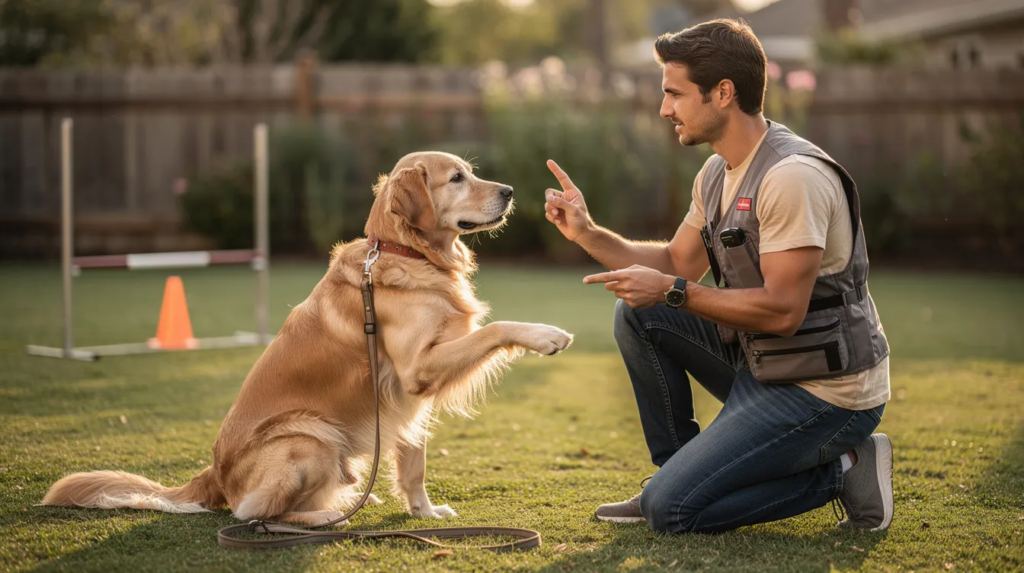
For dogs with a hearing deficit, use hand signals as primary cues rather than relying on verbal commands. Louder verbal cues delivered in lower pitches can help, since dogs retain sensitivity to lower frequencies longer. Modify commands for dogs with hearing or vision deficits by combining multiple sensory channels-pairing a verbal cue with a visible gesture and a tactile signal (like a light touch) ensures your dog can receive the message even when one sense is compromised. Use hand signals for dogs with hearing deficits as a direct line of communication that bypasses auditory limitations entirely.
Energy and Stamina Considerations
Older dogs fatigue more quickly and recover more slowly than their younger counterparts. Short training sessions are beneficial for older dogs-keep sessions to 5–10 minutes maximum, running two or three brief sessions per day rather than one extended period. Keep training sessions short to avoid mental fatigue, and watch for signs of exhaustion: excessive panting, lagging, shifting weight, or simply disengaging.
Training sessions for older dogs should be shorter and less strenuous than what you’d expect with younger dogs. Avoid scheduling training when it’s very hot, immediately after meals, or when medications may affect energy levels. Early morning tends to work well for most senior pets. Reducing distractions during training benefits older dogs by allowing them to focus their limited energy on the task at hand rather than filtering out environmental noise.
The bottom line: shorter, more frequent, lower-intensity sessions with adequate rest produce better results than pushing an older dog through such a strenuous exercise that leaves them sore and reluctant to train again.
Practical Senior Dog Training Implementation
With a solid understanding of both cognitive capacity and physical considerations, you’re ready to put training into action. The following framework integrates everything discussed so far into a practical, repeatable process that respects your senior dog’s needs while building new skills.
Step-by-Step Training Process
Breaking down complex behaviors into smaller steps aids in training older dogs. Here’s a systematic approach that works whether an owner patiently directs the training themselves or works alongside a professional trainer:
- Assessment: Start with a veterinary checkup to identify physical issues (arthritis, sensory loss, dental problems) and establish a cognitive baseline. Note what your dog still does well-learned behaviors from earlier training provide a foundation to build on. Evaluate your dog’s physical status before selecting any tricks.
- Environment Preparation: Set up a safe, comfortable training area with non-slip flooring, good lighting, and minimal distractions. Have soft padding available for positions requiring sitting or lying down. Keep high-value treats within easy reach.
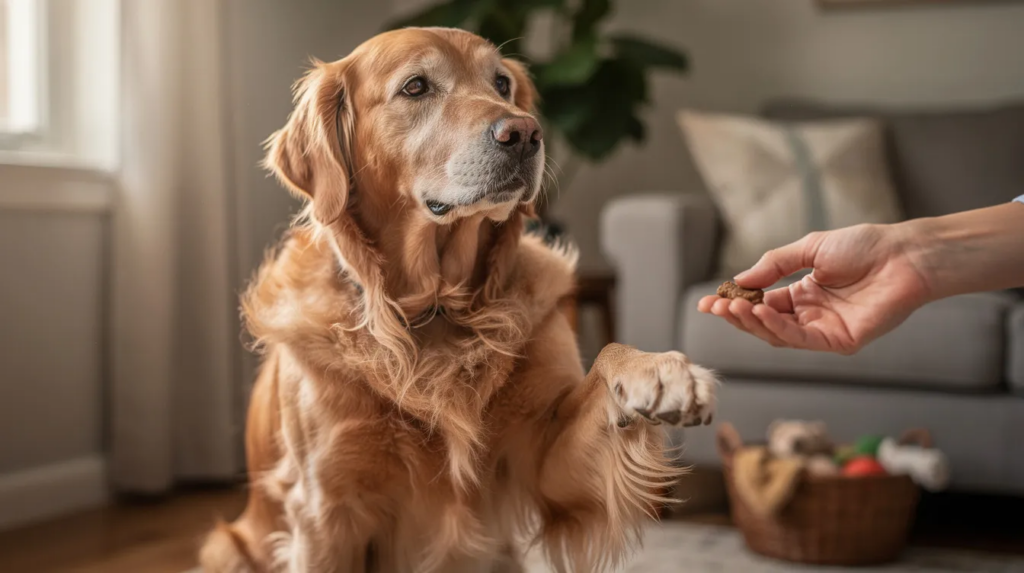
- Trick Selection: Pick tricks that match your dog’s age and physical condition. Start with low-effort, high-reward behaviors: target touches (nose to hand), the place command (going to a mat or bed), gentle paw lifts, or pushing a ball. Tricks like pushing a ball are suitable for older dogs because they engage the mind without demanding extreme physical effort. Avoid tricks that strain compromised joints.
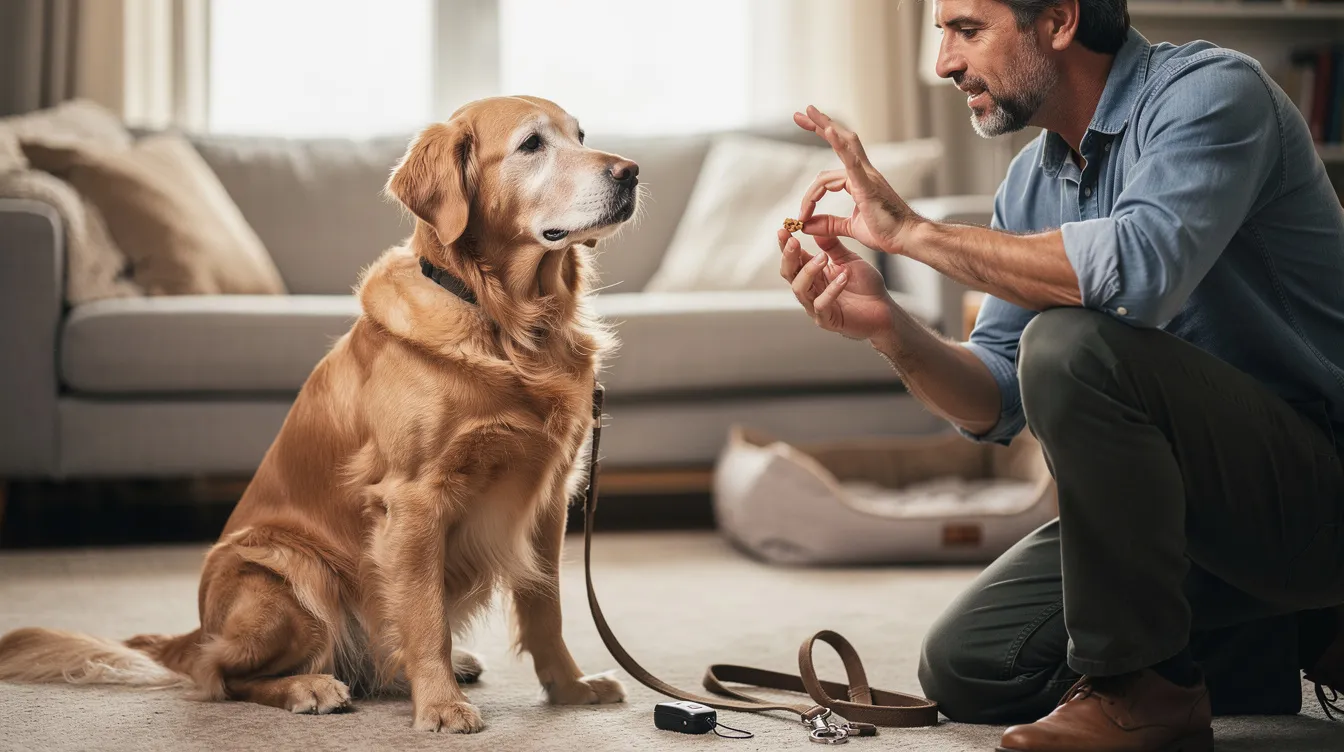
- Training Execution: Use positive reinforcement-clicker, treats, enthusiastic praise. Keep cues clear and consistent, incorporating both visual and tactile signals. Positive reinforcement is an effective training method for older dogs because it builds confidence rather than creating stress. Gradually fade lures and increase criteria in small increments.
- Progress Evaluation: Monitor improvement over time using simple metrics: how many repetitions before success, response latency, error rate. Celebrate incremental wins. Adjust expectations-what took days at age 2 may now take weeks, and that’s perfectly fine.
Training Method Comparison
Choosing the right approach matters significantly when working with senior dogs. Here’s how common training methods compare for this demographic:
| Criterion | Positive Reinforcement | Traditional/Correction-Based |
| Effect on Senior Dogs | Builds confidence, reduces stress, supports learning despite sensory or mobility limitations | May increase fear and discomfort; risks worsening cognitive decline |
| Session Structure | Short, frequent sessions (5–10 min) that maintain focus without overtaxing stamina | Longer sessions with intense repetition can lead to fatigue, stress, or injury |
| Physical Demand | Emphasizes low-impact, adaptable tricks; movements can be modified | May involve forceful corrections or high-energy demands that aggravate joint problems |
| Sensory Accommodation | Easily combines visual, tactile, and auditory cues; adapts to individual deficits | Often relies on immediate, strong responses that dogs with hearing or vision loss cannot provide |
The synthesis is clear: positive reinforcement with short sessions and sensory-adapted cues is substantially more effective and safer for senior dogs. This aligns with the golden rules of dog training that apply across all ages but become especially critical with older animals.
That said, even with the ideal method, specific challenges will arise. Let’s address the most common ones.
Common Senior Dog Training Challenges and Solutions
Every senior dog brings a few peculiarities to training that require creative problem-solving. Understanding these obstacles in advance-and having solutions ready-makes the difference between frustrating stagnation and steady progress.
Physical Limitations and Joint Issues
Physical limitations may affect older dogs’ ability to perform tricks, and this is the most common barrier pet owners face. Older dogs can learn low-impact tricks like shake and crawl, but even these may need modification depending on the individual dog.
Solution: Focus on tricks that don’t require full-body exertion-nose touches to a target, gentle paw waves from a standing position, or scent-finding games. For dogs with significant joint issues, choose tricks performed from a comfortable standing or lying position. Use soft padding beneath them, warm up with a gentle walk beforehand, and never push through visible discomfort. If your dog resists a particular position, respect that signal. Consider private training sessions where a professional can assess exactly which movements are safe for your specific dog.
Hearing and Vision Impairments
Older dogs may have difficulty understanding commands due to sensory deficits. A dog that seems to be ignoring you may simply not be receiving your signal-this is a common source of frustration for new owners of adopted dogs or pet owners who haven’t accounted for gradual sensory decline.
Solution: Transition to large, high-contrast hand signals as primary cues. Train in proximity so your dog can see your face and gestures clearly. Reduce background noise to minimize sensory overload. Tactile signals-a gentle touch on the shoulder or a vibration-can supplement both visual and auditory cues. Reward eye contact generously, as it becomes the foundation for all communication with a sensory-impaired dog. Many dogs with combined hearing and vision challenges learn remarkably well through touch-based learning techniques.
Decreased Motivation or Stubbornness
Some senior dogs seem less interested in training, and what pet owners interpret as stubbornness is often a combination of lower energy, reduced novelty-seeking, and possibly underlying discomfort. Dogs that were once actively curious may seem content to simply rest.
Solution: Identify what truly motivates your individual dog-experiment with different high-value treats, favorite toys, or types of praise until you find what sparks engagement. Keep sessions extremely short (even 2–3 minutes counts) and rotate trick types to maintain novelty. Training older dogs can improve their mental stimulation and bond with owners, so frame each session as connection time rather than work. Build confidence through easily achievable wins before increasing difficulty. Patience is non-negotiable; the time spent investing in short, positive sessions pays dividends in your dog’s behavior and overall wellb-eing. If motivation issues persist despite your best efforts, a professional behavior assessment can rule out pain or cognitive issues underlying the resistance.
Conclusion and Next Steps
Senior dogs are far more capable learners than the old saying suggests. With appropriate modifications for physical comfort, sensory changes, and energy levels, mature dogs can master new routines, build new skills, and enjoy a fun activity that strengthens the bond between dog and owner. The science is unambiguous: dogs at every stage of life retain the neuroplasticity needed to dog learn effectively. The limitations are real but manageable-and the benefits to cognitive health, emotional well-being, and quality of life make the effort thoroughly worthwhile.
Here’s how to get started today:
- Assess your dog’s current condition: Note any mobility restrictions, sensory changes, or medical issues. Schedule a vet visit if needed.
- Choose your first trick: Start with something simple-a nose touch to your palm or a gentle paw lift. Pick tricks that match your dog’s respective ages and physical capacity.
- Set up your space: Find a quiet, well-lit area with non-slip flooring and gather your treats.
- Run your first session: Keep it to 5 minutes. Use positive reinforcement, celebrate every small success, and end on a high note.
If you’re looking to explore advanced obedience training or need guidance with behavior modification for an older dog, working with an experienced professional can accelerate results while ensuring safety. Understanding how long training takes helps set realistic expectations, and proofing techniques can help your senior dog generalize new tricks across different environments.
Additional Resources
For complex behavioral issues-reactivity, aggression triggered by pain, or significant cognitive decline-a professional consultation provides the individualized assessment that general advice cannot. These situations often require evaluating medical causes alongside behavioral approaches.
Specialized senior dog programs, including in-home training options, can be particularly valuable for dogs with mobility limitations or anxiety about new environments. A board-and-train program with senior-specific accommodations provides immersive learning in a controlled setting.
For personalized senior dog training plans tailored to your dog’s specific needs, abilities, and temperament, contact Off Leash K9 Training Toledo to schedule a consultation. Every dog-regardless of age-deserves the chance to learn, engage, and thrive.