Introduction
Dog enrichment activities are structured mental and physical challenges designed to satisfy a dog’s natural behaviors like sniffing, foraging, and problem-solving. When dogs lack these outlets, the result is predictable: destructive chewing, excessive barking, hyperactivity, and anxiety. Dogs should be getting at least 30 minutes of enrichment every day, and most pet owners underestimate how much structured stimulation their dog actually needs.
This guide covers mental stimulation, physical exercise, food-based enrichment, and environmental enrichment for dogs of all ages and energy levels. It does not cover basic obedience commands like sit, stay, or heel (for that, see our guide on dog obedience training in Toledo). The target reader is a Toledo area dog owner dealing with boredom-related behaviors who wants practical, research-backed enrichment ideas they can start using today.
The direct answer: dog enrichment activities reduce problematic behaviors by giving dogs opportunities to express instinctual behavior through structured challenges. Both physical and mental enrichment are important for a dog’s well-being. Mental stimulation can make a huge difference in your dog’s happiness and behavior.
Here is what you will learn from this guide:
- How enrichment reduces anxiety and stress by engaging a dog’s brain through instincts
- Why mentally tired dogs perform better during training sessions
- Which types of enrichment activities match your dog’s energy level and age
- How to build a daily enrichment schedule using household items and simple tools
- When to seek professional help for persistent unwanted behaviors
Understanding Dog Enrichment
Environmental enrichment means providing stimuli beyond basic care (feeding, shelter, vet visits) that allow dogs to express natural behaviors. Enrichment activities engage a dog’s mind through olfaction, foraging, object manipulation, movement, and social interaction. Dogs need enrichment to express natural behaviors like sniffing and playing; without these outlets, they redirect that energy into behaviors owners find problematic.
Enrichment also supports training goals directly. A dog that has spent 15 minutes working through a puzzle feeder before an obedience session arrives calmer, more focused, and less reactive to distractions. Keeping your dog stimulated helps prevent boredom and behavioral issues, and dogs learn faster when their baseline need for mental engagement has been met.
Mental Stimulation Benefits
Cognitive challenges redirect destructive energy into productive problem-solving. In a randomized controlled trial with 107 shelter dogs, dogs receiving food-toy enrichment plus behavior training showed a striking shift: 65% of the enrichment group increased relaxed behaviors (sitting, lying down) compared to 22% of control dogs. Jumping behavior dropped in 57% of enriched dogs versus 9% in the control group after just three days.
Puzzle toys challenge a dog’s brain by making them work for their food or treats. This mental fatigue is productive; it reduces distractibility and increases receptiveness during formal training. Short training sessions can provide effective mental enrichment for dogs, and game-based learning approaches combine enrichment with skill building. Enrichment activities improve dogs’ cognitive health and problem-solving skills, which is particularly relevant for aging dogs. Cognitive enrichment helps prevent cognitive decline in senior dogs, giving owners of older pets a concrete reason to maintain enrichment routines.
Physical Enrichment Benefits
Physical enrichment activities reduce stress and anxiety in dogs while building coordination, balance, and dog’s confidence. Obstacle courses challenge dogs’ balance and confidence, and the delayed rewards built into physical challenges (waiting for a cue, controlling body position through a tunnel) reinforce impulse control.
Interactive games like fetch and tug can build impulse control. Physical enrichment activities improve dogs’ fitness and coordination, and these skills transfer directly to leash manners and reactivity management. A dog that has learned to wait, shift direction, and control its body through an obstacle course responds better when asked to heel on a walk.
The reason different enrichment types work best together: a global review of enrichment studies found that combining four or more categories (sensory, structural, social, food) produced positive behavioral outcomes in nearly 100% of cases. Single-type enrichment helps, but variety produces measurably better results.
Types of Dog Enrichment Activities
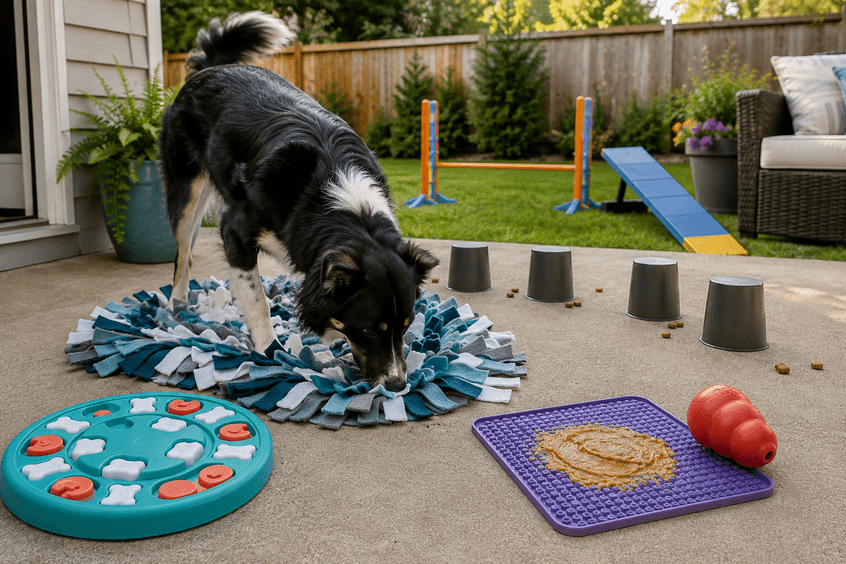
Research classifies enrichment into four main categories: food-based (puzzle feeders, scatter feeding), sensory/olfactory (scent games, nose work), physical/structural (obstacle courses, agility), and social/interactive (owner play, dog-dog play). Each category engages different instincts and supports different training goals. Enrichment activities should engage a dog’s natural behaviors like sniffing and foraging.
Food-Based Enrichment
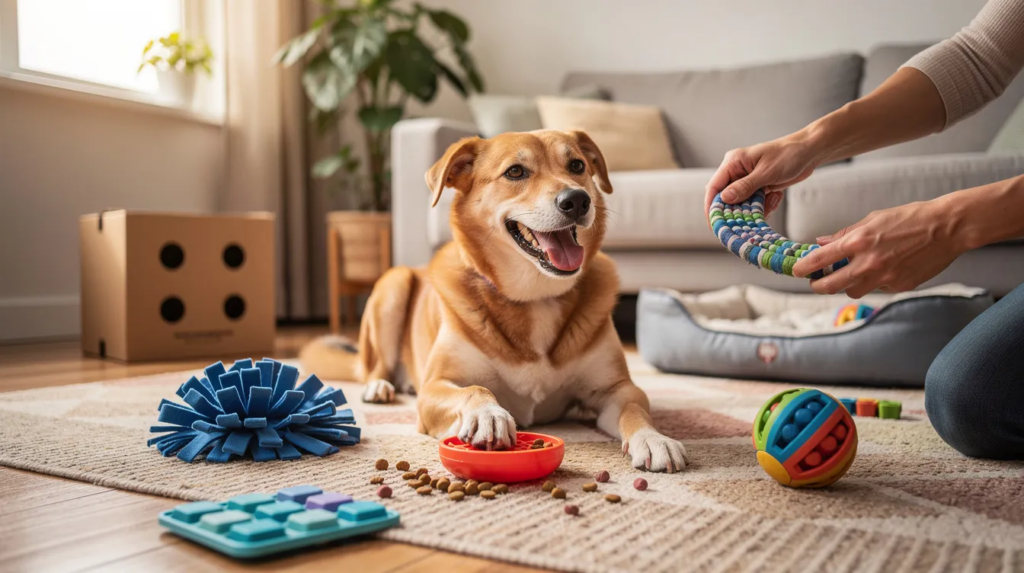
Food-based enrichment turns mealtime into a problem-solving session. Puzzle feeders stimulate dogs’ brains and slow down eating, which reduces food-seeking behaviors and begging. A survey of 1,750 dog owners found that enrichment feeding using Kongs, food puzzles, and activity toys correlated with perceived reductions in begging and training difficulties. Mental stimulation was the most common benefit owners cited.
Tools for food-based enrichment include:
- Puzzle toys and puzzle feeders: Require dogs to slide, lift, or push compartments to access treats
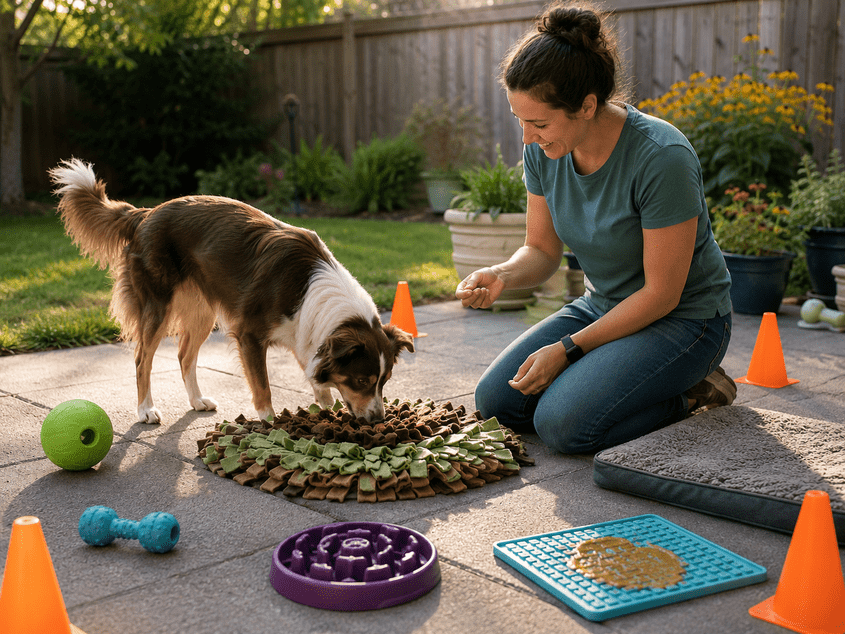
- Snuffle mats: Encourage a dog’s natural foraging instincts by hiding treats inside folds of fabric, letting the dog sniff out each piece
- Frozen Kongs: Fill with wet food or pumpkin puree, freeze, and provide hours of licking engagement. Frozen Kongs and lick mats can soothe dogs while keeping them occupied
- Lick mats: Spread peanut butter or wet food on a rubber mat for calming, repetitive licking. Chewing and licking activities can serve as calming enrichment for dogs
- Scatter feeding: Transforms mealtime into a scent-tracking game by spreading kibble across grass or a snuffle mat
DIY activities can provide effective enrichment without expensive toys. Place treats inside a muffin tin covered with tennis balls so your dog must remove each ball to reach the food. A cardboard box filled with crumpled paper and hidden treats lets dogs safely rip apart the box to find rewards. You can also punch holes in a plastic bottle, fill it with kibble, and let your dog roll it around to dispense food. Even a paper bag with a smelly treat inside gives a dog five minutes of focused engagement.
One note on food enrichment: if your dog has dietary restrictions, use portions of their regular kibble rather than extra treats to avoid overfeeding. Veterinary guidance emphasizes varying enrichment activities based on the dog’s needs.
Scent Work and Nose Games
Dogs process the world through scent, and scent work encourages deep breathing and relaxation in dogs. In shelter studies, olfactory enrichment reduced vocalizations and jumping while increasing exploration and foraging behaviors.
The simplest scent games require nothing but treats and space. The “Find It” game encourages dogs to use scent-tracking indoors: place treats in one room while your dog waits in another, then release them to sniff out the rewards. Treasure hunts work the same way on a larger scale. Hide food or a favorite toy in different rooms around the house and let your dog sniff each one out. Nose work games help dogs build tracking and scenting skills, and even a short session can tire out a high-energy dog.
For more structured scent work, research on scented enrichment items found that dogs played more with individually preferred scented toys and showed increased activity. Individual preferences varied, so try different scent items to discover what engages your specific dog. One finding worth noting: activity with preferred scent toys declined over repeated exposure (p = 0.006), confirming that rotation keeps enrichment effective. Rotating toys can make old toys feel new and exciting for dogs.
Scent work builds dog’s confidence because success is driven by instinct rather than learned commands. This makes nose games especially useful for reactive or fearful dogs who need confidence-building before progressing to more social forms of enrichment.
Physical Challenge Activities
Physical play and structured movement challenges round out a dog’s day by burning energy and building body awareness. In a pilot study with 10 assistance dogs, conspecific play and playhouse activities produced the largest reductions in stress and alert behaviors among seven enrichment types tested.
Agility training can be done at home by setting up obstacle courses with items you already own: broomsticks across chair legs for jumps, a blanket draped over chairs for a tunnel, cushions arranged for weaving. Obstacle courses can improve a dog’s balance and confidence, and terrain walks expose dogs to different surfaces for exploration.
A flirt pole (a toy attached to a rope on a stick) channels prey drive into controlled play; swing it so your dog chases, then practice “drop” and “wait” commands between bursts. This combines physical exercise with impulse control in a single activity. Creating a digging pit (a sandbox filled with loose soil and buried toys) can satisfy a dog’s natural digging instinct without sacrificing your garden.
For many dogs, especially senior dogs, physical challenges need scaling. Shorter sessions, lower jumps, and gentler terrain walks keep older dogs engaged without risking joint strain. Engaging activities combine mental challenges with physical movement for dogs of any age.
Implementing Enrichment in Daily Training
Enrichment works best when woven into everyday life alongside obedience work. Use enrichment tools as rewards after training sessions, or start with a calming enrichment activity (like a lick mat) to settle a reactive dog before introducing distractions. Enrichment strengthens the bond between dogs and their owners because both activities require collaboration. For Toledo dog owners dealing with seasonal challenges, indoor enrichment like food puzzles and scent games keeps dogs stimulated during cold winters and hot summers.
Daily Enrichment Schedule
Dogs should be getting at least 30 minutes of enrichment every day, spread across multiple short sessions rather than one long block. Here is a practical daily routine:
- Morning (5-10 minutes): Start the dog’s day with a scent activity. Let your dog sniff freely on a long leash walk, or hide treats in the yard for a quick treasure hunt. Long leash walks allow dogs to explore and sniff freely.
- Mid-morning (10-15 minutes): Brief physical play; fetch, tug, or a flirt pole session. Hide-and-seek is a fun game that promotes mental engagement for dogs.
- Afternoon (15-20 minutes): Food based enrichment while you work. A frozen Kong, puzzle feeder, or snuffle mat keeps your dog entertained without requiring your direct involvement.
- Late afternoon (5-10 minutes): Short obedience or trick training session. Trick training provides mental stimulation for dogs of all ages. Training games exercise the brain and improve problem-solving skills.
- Evening (30-60 minutes): Longer physical activity; a walk, fall-themed outdoor training, or dog park socialization.
- Before bed (5-10 minutes): Calming enrichment to wind down. A chew toy, gentle massage, or playing classical music. A 2018 study found classical music calms dogs effectively, and dogs enjoy watching DogTV designed for their senses.
Rotate enrichment items every few days to prevent habituation and keep your dog engaged.
Enrichment Intensity Comparison
| Activity Type | Time Needed | Training Benefits | Best For |
| Food puzzle (Kong, snuffle mat, lick mat) | 5-15 min | Slows eating, reduces food-seeking, engages brain | All energy levels; great for solo time |
| Scent games and nose work | 10-20 min | Builds focus, dog’s confidence, reduces barking | Moderate energy; impulsive or reactive dogs |
| Agility and obstacle course | 20-45 min | Physical exertion, impulse control, coordination | High energy; young, physically capable dogs |
| Obedience with enrichment reward | 5-10 min | Reinforces commands in varied contexts, distraction tolerance | All dogs; especially those in behavior modification |
| Calming enrichment (chew toys, lick mats, music) | 5-10 min | Reduces anxiety, aids settling, helps reactive dogs unwind | Low energy periods; senior dogs; post-exercise |
Scale intensity down during extreme heat, after vet procedures, or for dogs with physical limitations.
Common Challenges and Solutions
Enrichment prevents boredom and destructive behavior in dogs, but implementing it consistently comes with obstacles. Here are the most common ones Toledo dog owners encounter and how to address each.
Dog Loses Interest Quickly
Habituation is natural. Research confirms that dogs play less with familiar enrichment items over repeated exposure. The fix: rotate between different categories rather than repeating the same puzzle daily. Monday might feature a food puzzle using a muffin tin and tennis balls, Tuesday a scent trail with treats hidden around the house, Wednesday a ball pit with kibble scattered in it. Start each new activity at an easy difficulty so the dog succeeds, then increase complexity over several sessions. Use different household items (plastic containers, a t shirt tied around a treat, a cardboard box) to keep textures and challenges varied.
Limited Time for Activities
The most common barrier to enrichment feeding reported in the 1,750-owner survey was lack of time. The workaround: choose activities that run without active supervision. A frozen Kong takes 20-45 minutes to finish and requires zero owner involvement after setup. Scatter feeding kibble across a snuffle mat takes 30 seconds to prepare and gives your dog 10 minutes of focused sniffing. DIY enrichment using a plastic bottle with small holes punched in it and filled with kibble lets your dog roll and solve problems independently. Five-minute sessions spread across the day work better than one 30-minute block.
Destructive Behavior During Enrichment
Some dogs rip apart enrichment toys rather than working them as intended. Supervise the first few sessions with any new item, and choose durable, non-toxic materials (avoid plastic containers that splinter, remove staples from cardboard). If a dog destroys puzzle toys instead of solving them, step back to simpler activities like scatter feeding or lick mats, then gradually introduce more complex items. Practice “leave it” and “drop” commands during enrichment to reinforce impulse control. Dogs that consistently destroy items or show escalating frustration during enrichment may benefit from a professional behavior consultation to identify underlying issues.
Conclusion and Next Steps
Enrichment reduces stress and anxiety in dogs, improves focus during training, and prevents the boredom-driven behaviors that dog lovers find most frustrating. Dogs benefit from activities that promote natural behaviors, and combining food, scent, physical, and social enrichment produces better outcomes than relying on a single type. Cognitive activities strengthen the bond between dogs and their owners by turning everyday activities into collaborative engagement.
Start with these steps:
- Pick 2-3 enrichment activities from different categories (one food puzzle, one scent game, one physical challenge) and test them over the next week
- Observe which activities hold your dog’s attention longest and adjust the rotation accordingly
- Build a weekly schedule: swap activities daily to prevent habituation
- Use enrichment as a reward after obedience sessions to reinforce training goals
- For dogs with persistent behavioral issues (reactivity, aggression, severe anxiety), pair enrichment with professional training rather than treating it as a standalone solution
Additional Resources
For dogs needing structured enrichment plans alongside behavior modification, Off Leash K9 Training Toledo offers private training sessions and behavior consultations that integrate enrichment protocols with distraction-proof obedience work. If you are deciding whether to work with a professional, enrichment activities are a strong starting point, but persistent unwanted behaviors often require expert assessment.
The ASPCA’s enrichment scheduling guide provides additional templates for daily enrichment rotations. For dog owners just starting training, combining enrichment with early obedience work sets a foundation that makes every stage of training more effective.