Introduction
Puppy-proofing your home is the single most important safety step you can take before bringing a new puppy through your front door. Between 8 and 16 weeks of age, puppies are naturally curious, teething, and completely unable to distinguish between a safe chew toy and a live electrical cord. A structured approach to puppy proofing prevents emergencies and gives your pup the freedom to explore without danger.
This guide covers indoor and outdoor safety measures room by room, explains the behavioral science behind why puppies get into trouble, and provides a step-by-step process you can complete before your new pup arrives. It’s written specifically for new puppy parents in the Toledo area preparing for their first six months with a dog. Advanced behavioral training falls outside the scope here and requires professional guidance.
The direct answer: puppy proofing involves securing hazardous items like medications, chemicals, and toxic foods behind locked cabinets, blocking access to dangerous areas with baby gates, organizing electrical cords out of reach, and creating designated safe spaces where your puppy can explore unsupervised without risk.
By the end of this guide, you’ll understand how to:
- Prevent emergency vet visits caused by accidental poisoning, choking, or electrical shock
- Protect your valuable belongings from destructive behavior during teething
- Establish safe boundaries that support positive training habits
- Create a stress-free, puppy-safe environment that promotes healthy development
- Build a foundation for crate training, obedience, and socialization
Understanding Puppy Behavior and Safety Needs
Before you start rearranging furniture and installing childproof latches, it helps to understand why puppies are so determined to chew, mouth, and investigate every object at ground level. Puppy proofing tips are far more effective when grounded in what’s actually driving your pup’s behavior.
Puppies begin teething around 3 weeks of age, with baby teeth falling out and adult teeth emerging between 3 and 4 months. The full permanent set of 42 teeth typically arrives by about 6 months. Throughout this 4-to-6-month teething phase, chewing provides relief for sore, inflamed gums. But teething isn’t the only driver. Puppies explore their world through their mouth the way human toddlers use their hands – everything gets tasted, tested, and sometimes swallowed.
Natural Puppy Behaviors That Create Risks
Chewing and mouthing are not destructive behaviors in the way most new owners think. They’re developmentally normal. A puppy chews chewable objects for teething relief, explores unfamiliar textures through mouthing, and investigates whether things taste good by licking and biting. Research confirms that mouthing behavior is one of the most common problem behaviors among companion dogs, with rates significantly higher in dogs under one year.
The safety connection is direct: a pup that mouths everything will eventually find electrical cords, small objects like coins and paper clips on the floor, cleaning supplies under the kitchen sink, or toxic plants on a low table. Each of these poses a real risk of electrical shock, choking, poisoning, or chemical burns. Redirecting chewing behavior to toys prevents destructive habits and keeps your puppy out of danger.
Critical Development Windows
The period between roughly 3 and 16 weeks of age is a critical socialization window. During this time, puppies are most open to new people, environments, sounds, and surfaces. Research dating back to the landmark Freedman studies demonstrated that puppies deprived of social exposure during this window develop severe fear responses to humans and other dogs – some permanently. Early puppy socialization is crucial to prevent behavior problems.
This window overlaps almost perfectly with peak teething and curiosity. A puppy arriving home at 8 to 9 weeks is entering the most intense exploration phase of its life. Everything in your house is new, interesting, and potentially dangerous. That’s why this age demands maximum environmental control: your home needs to be safe enough for exploration while still allowing the positive exposures that build confidence.
Size and Physical Limitations
A puppy’s small size creates hazards that adult dog owners rarely consider. Low to the ground, unable to see over thresholds, and with developing coordination and vision, puppies squeeze into spaces behind furniture, tumble down stairs, climb on unstable shelves, and access items stored at floor level. They can slip through fence gaps that seem impossibly narrow and reach under doors into rooms you assumed were closed off.
These physical limitations multiply every hazard that exists at their eye level – which is precisely why experts recommend that you inspect your home at puppy eye level to spot hazards before your puppy arrives. Understanding these behavioral and physical realities transforms puppy proofing from a checklist into a logical, room-by-room safety strategy.
Essential Puppy-Proofing Areas
With your puppy’s natural behaviors and limitations in mind, it’s time to walk through each area of your house and address the specific potential hazards waiting at floor level and below counter height.
Kitchen and Dining Areas
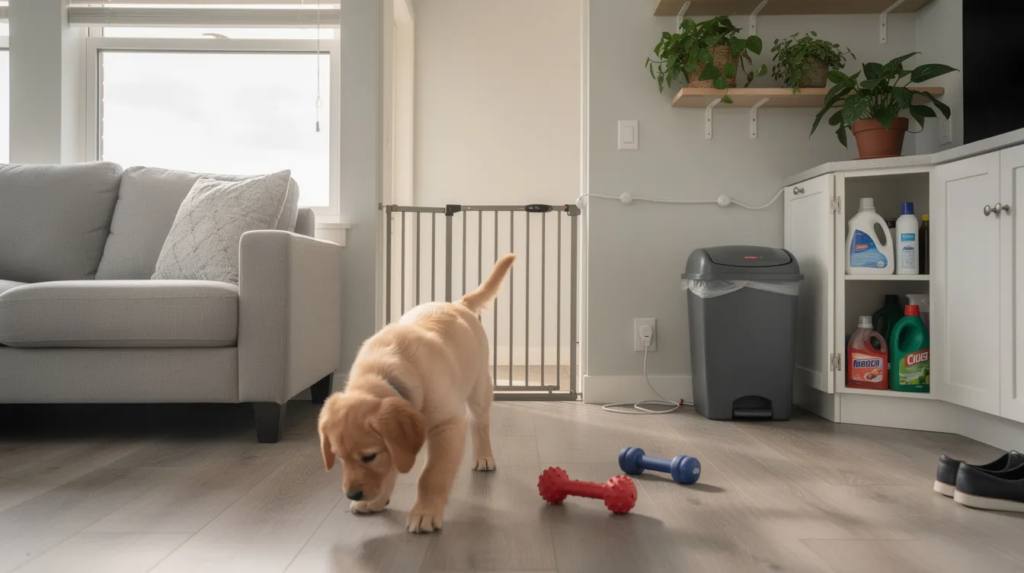
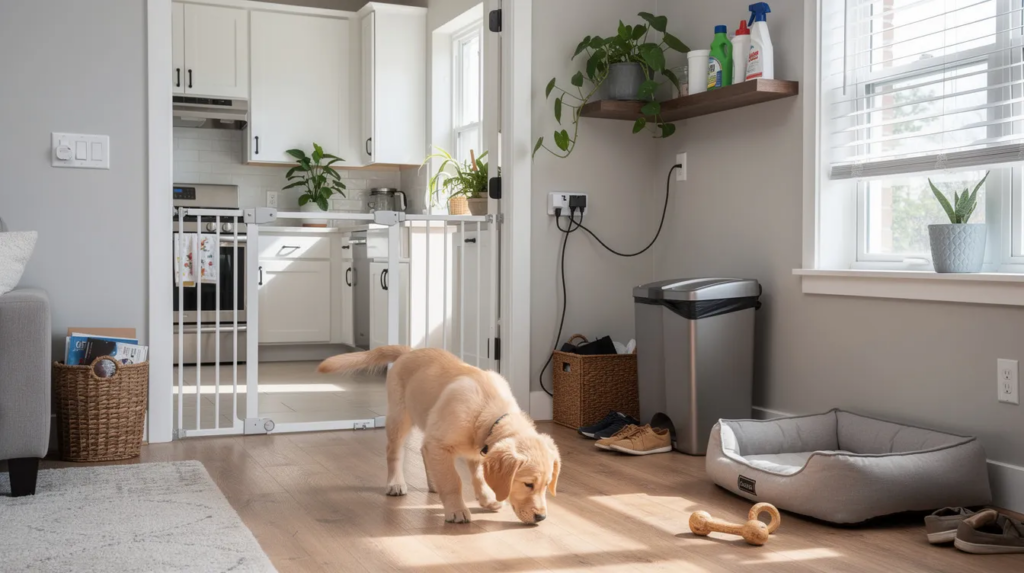
The kitchen concentrates more dangers per square foot than any other room. Start with the cabinets: use childproof latches on every lower cabinet, especially those storing cleaning supplies, dish detergents, bleach, and sharp utensils. According to AKC poison safety data, strong detergents and formaldehyde-releasing cleaning agents are dangerous if ingested or even inhaled by a small pup.
Secure trash cans with locking lids to prevent access, or store garbage bins behind closed cabinet doors. Rotting food, bones, plastic wrappers, and packaging in an open trash can create choking and toxicity risks. Store toxic foods such as chocolate and grapes out of reach of puppies – along with onions, garlic, avocado, and anything containing xylitol (commonly found in sugar-free gums and some peanut butter brands).
Organize electrical cords from appliances using cord covers or cable organizers. A teething puppy will find a dangling blender cord irresistible, and chewing through insulation can cause burns, shocks, or worse. Keep all cords either hidden behind appliances or elevated out of sight.
Living Spaces and Bedrooms
Living rooms and bedrooms are where small objects accumulate: coins, jewelry, rubber bands, buttons, children’s small toys, and shoes left on the floor. Remove small choking hazards like coins and paper clips from the floor before your puppy has access. These items pose esophageal and choking risks for a curious pup that mouths everything.
Organize electrical cords to prevent chewing and shocks – this applies to lamp cords, phone chargers, TV cables, and power strips throughout these rooms. Anchor heavy furniture, bookcases, and TVs to walls to prevent tipping if a puppy climbs or bumps into them. Low tables and shelving should be cleared of breakable or swallowable items.
Store medications and chemicals securely out of your puppy’s reach. Even a single dropped pill can be lethal to a small dog. Human medications – both OTC and prescription – are among the leading causes of accidental poisonings in dogs. Cosmetics, hair products, and personal items should be stored in closed drawers or elevated shelving.
Bathroom Safety Measures
Bathrooms combine water, chemicals, medications, and electrical devices in a small space. Keep toilet lids closed or install toilet locks – an unsupervised puppy can fall into an open toilet and potentially drown. Store all cleaning products and bathroom chemicals in inaccessible cabinets with childproof latches.
Medication cabinet security is critical. Move all prescription and over-the-counter medications to high, locked cabinets. Razors, scissors, and other sharp objects should be placed well out of reach. Unplug and store hair dryers, electric shavers, and curling irons after use – both the electrical cords and heated surfaces present dangers.
With indoor rooms addressed, the next layer of puppy proofing extends to your yard, garage, and any outdoor space your puppy will access.
Step-by-Step Puppy-Proofing Process
Now that you understand the room-specific hazards, here’s a systematic process to implement your puppy home safety plan efficiently, starting well before your new puppy arrives.
Pre-Puppy Home Assessment
Conduct your assessment 2 to 3 weeks before your pup comes home. This gives you time to purchase supplies, install hardware, and address anything that requires repair or modification.
- Get on your hands and knees in every room and inspect your home at puppy eye level – note anything accessible, chewable, swallowable, or toxic at ground level
- Identify all electrical cords below 3 feet and plan concealment or protection for each one
- Catalog every cabinet, drawer, and door that a puppy could push open, nose into, or paw at
- Walk your yard perimeter checking for gaps in fences, escape routes, toxic plants, and standing water
- Remove toxic plants like Sago Palm from your home and check outdoor beds for azaleas, daffodils, and other dangerous species common in Toledo-area yards
- Inventory all medications, chemicals, cleaning supplies, and toxic foods in the house and plan secure storage
- Establish designated puppy areas – decide which rooms will be accessible and which will remain off-limits
- Identify your safe space: the room or area where your puppy will stay when unsupervised, using a crate or pen
Priority Safety Installations
These are the immediate safety measures to complete before your puppy’s first day home:
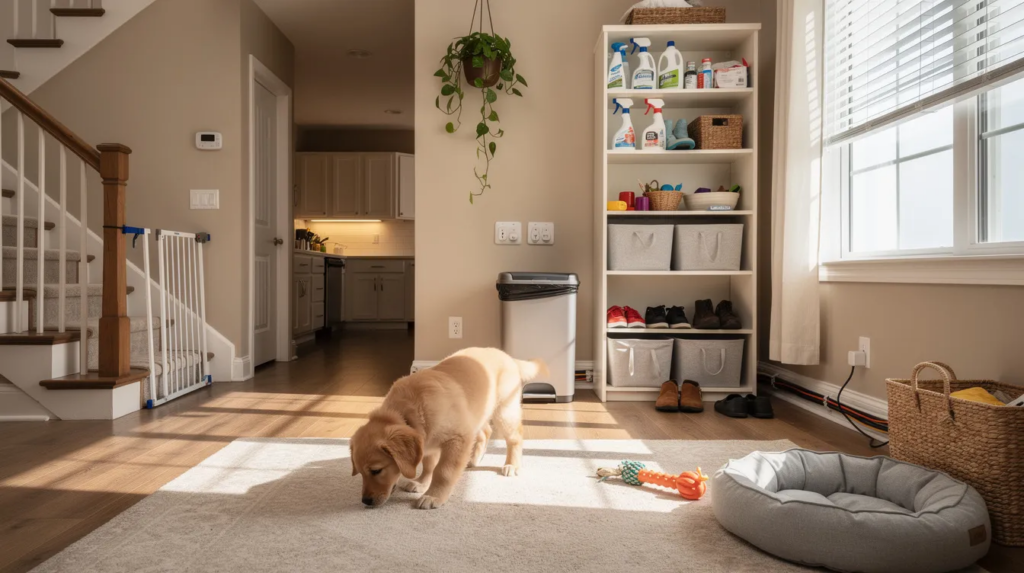
- Install baby gates to block off areas that are unsafe for puppies – hardware-mounted gates are more secure than pressure-mounted, especially at stairways
- Attach childproof latches on all lower kitchen, bathroom, and laundry cabinets
- Install cord covers or cable organizers on every exposed electrical cord at floor level
- Replace or secure all trash cans with locking lids throughout the house
- Set up a crate or puppy pen in your designated safe zone – crate training can assist in managing a puppy’s behavior effectively and provides structure for early obedience development
- Place outlet covers or install tamper-resistant outlets in all rooms the puppy will access
Indoor vs Outdoor Safety Comparison
| Category | Indoor Hazards | Outdoor Hazards | Prevention Methods |
| Toxic Ingestion | Medications, cleaning supplies, chocolate, xylitol products | Antifreeze, fertilizers, rodenticides, cocoa mulch | Locked cabinets indoors; secured garage storage; eliminate cocoa mulch |
| Choking & Swallowing | Small objects, coins, rubber bands, children’s toys | Sticks, rocks, garden debris, wild mushrooms | Floor sweeps daily; supervise outdoor play; clear yard regularly |
| Electrical & Burns | Cords, power strips, space heaters | Outdoor lighting, extension cords, grill areas | Cord covers indoors; elevate or bury outdoor wiring |
| Escape & Injury | Open doors, stairways, balconies | Fence gaps, unfenced pools, open gates | Baby gates and door stops; fence inspection and pool barriers |
| Toxic Plants | Sago palm, lilies, philodendron | Azaleas, daffodils, oleander | Remove indoor plants; identify and remove or fence off outdoor species |
For Toledo-area families, pay special attention to outdoor hazards during winter: road salt, ice melt chemicals, and antifreeze are extremely dangerous. Antifreeze has a sweet taste that dogs find highly palatable, and even a small amount causes acute kidney failure. Check your garage floor regularly for leaks and store all automotive chemicals on high shelves behind closed doors.
Supervise young puppies outdoors and check your yard for gaps in fences or toxic plants regularly. Puppy-proofing is an ongoing process and requires reassessment as puppies mature – a gap that seemed too small last month may be a perfect escape route for a growing pup.
Common Puppy-Proofing Challenges and Solutions
Even with a thorough plan, real life introduces complications. Here are the most common challenges Toledo-area families face and practical solutions for each.
Limited Space and Budget Constraints
Not every family can invest in custom cabinetry or permanent fixtures. Pressure-mounted baby gates work well for interior doorways and typically cost $20 to $40. DIY cord management using split wire loom tubing (under $10 at hardware stores) protects cords effectively. Use childproof latches on cabinets – they cost roughly $2 to $5 per latch and install in minutes. Rearranging furniture to block access to problem areas costs nothing and is often the fastest fix.
Confine puppies to a designated safe zone when unsupervised using a crate or pen. A quality crate serves double duty: it provides safety when you can’t supervise and supports the crate training process that builds long-term good behavior.
Multi-Pet Households
When other dogs or cats already live in your home, their food, toys, and belongings become new hazards. Cat food, for example, is high in fat and can cause digestive issues for puppies. Existing pet toys may be sized wrong – too small for a puppy that might choke. Elevate cat food and litter boxes. Separate feeding areas using baby gates that allow cats through but block the puppy. Establish designated puppy areas that give each animal their own space during the adjustment period.
Apartment Living and Rental Restrictions
Renters often can’t drill into walls or make permanent modifications. Use pressure-mounted gates instead of hardware-mounted ones where possible (except at stairs, where security matters more – discuss options with your landlord). Adhesive cord covers, weighted trash cans, and removable outlet covers leave no marks. Many landlords are receptive when you explain safety modifications – document everything and offer to restore original condition at move-out. Puppies should have appropriate chew toys to redirect their natural teething instincts, reducing damage to rental property.
Inconsistent Family Rules
The most secure puppy proofing fails when family members leave doors open, drop medications, or let the puppy access off-limits rooms. Establishing a routine helps reduce puppy anxiety and confusion. Hold a household meeting before the puppy arrives to agree on which rooms are accessible, who checks gates and doors, and how everyone responds to mouthing or chewing behavior.
Puppies learn best through positive reinforcement training methods – consistency across all family members is what makes training stick. If children are part of the household, teach them to keep small items, shoes, and toys off the floor and to close doors and gates behind them. A professional puppy training consultation can help align the entire family on rules and techniques.
Conclusion and Next Steps
Proactive puppy proofing is not a one-time task – it’s an ongoing process that evolves as your puppy grows. Periodically reassess the house from a puppy’s perspective as they grow, because a larger dog reaches higher shelves, jumps onto furniture, and tests boundaries that were previously out of range. The investment you make in securing your home now prevents dangerous accidents, protects your belongings, and builds the safe environment where positive training thrives.
Your immediate next steps:
- Conduct a 48-hour home safety assessment using the room-by-room process outlined above – get on your hands and knees and see what your puppy will see
- Purchase essential supplies: baby gates, childproof latches, cord covers, locking trash cans, a crate, and size-appropriate chew toys
- Create consistent routines for feeding and potty breaks before your puppy arrives so the household is ready
- Schedule a professional puppy training consultation to establish a training plan that complements your puppy-proofed home
Once your home is secure, the natural next phases are crate training, basic obedience commands like “leave it,” and a structured socialization plan that takes advantage of the critical development window before 16 weeks.
Additional Resources
Room-by-Room Puppy-Proofing Checklist:
- Kitchen: cabinet locks, trash can security, cord covers, toxic food storage
- Living room/bedrooms: small object sweep, cord protection, furniture anchoring, medication storage
- Bathroom: toilet lock, chemical storage, medication cabinet, sharp object removal
- Garage: antifreeze containment, chemical storage, tool security
- Yard: fence inspection, toxic plant removal, pool/water barriers, mulch check
Emergency Vet Contact Template for Toledo-Area Families: Keep the following information posted on your refrigerator and saved in your phone: your primary veterinarian’s number, the nearest 24/7 emergency animal hospital in the Toledo area, and the ASPCA Animal Poison Control Center hotline (888-426-4435).
Professional Training Support: Off Leash K9 Training Toledo offers puppy training consultations that cover safety, obedience foundations, and socialization planning – helping you build on your puppy-proofed home with structured training from day one.