Introduction
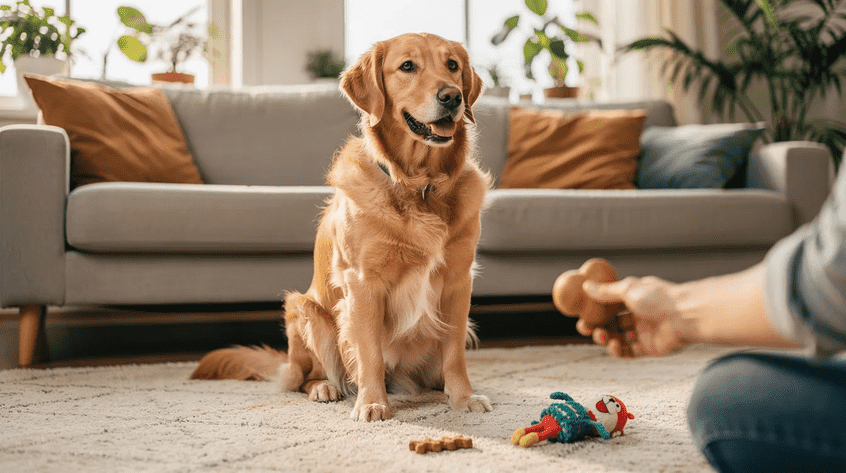
Impulse control games are structured training exercises that teach dogs to pause, think, and make calm choices instead of acting on every urge. These activities use positive reinforcement to reward patience and self-restraint, turning everyday moments-like mealtime or walking through a door-into opportunities for your dog to practice better decision-making. Dogs learn to wait for rewards through impulse control training, and the results translate directly into a calmer, safer companion at home and in public.
This guide covers 12 proven impulse control games for dogs of all ages and skill levels, from basic food exercises that take five minutes to set up, to advanced multi-step challenges that build genuine behavioral resilience. Whether your dog struggles with jumping on guests, grabbing food off the counter, rushing through doors, or pulling on the leash, these games address the root cause: an inability to resist immediate impulses. Pet parents in Toledo and beyond will find practical, step-by-step instructions they can start using today.
The short answer: Impulse control games are interactive training exercises that reward dogs for waiting, thinking before acting, and choosing calm behavior over impulsive reactions. Games can effectively teach dogs emotional self-control, and consistent practice builds habits that stick.
By the end of this guide, you will:
- Know how to teach your dog reliable door manners and calm greetings
- Have a system for calmer, more patient feeding times
- Understand how to reduce reactivity and leash pulling through structured play
- Be able to select the right games based on your dog’s age, breed, and current skill level
- Have a framework for building stronger owner-dog communication through daily practice
Understanding Impulse Control in Dogs
Impulse control is a dog’s ability to override natural instincts-chasing, grabbing, lunging-and wait for permission before acting. Unlike sit or down position, which are discrete commands, impulse control is a broader cognitive skill. It requires the dog to suppress an automatic response in favor of a trained alternative, such as holding a sit while the front door opens or ignoring a dropped treat on the floor.
Most dogs are not born with strong self control. While some breeds and individual temperaments lean toward patience, the capacity to resist impulses is something that must be developed through consistent, structured practice. Teaching self-control prevents common dog behavior issues like jumping, stealing food, and barking. A patient dog is better behaved and less demanding, which makes life more enjoyable for everyone in the house.
Why Dogs Struggle with Self-Control
Dogs struggle with impulse control for three interconnected reasons.
First, evolutionary drives encourage immediate action. Prey drive, food-seeking behavior, and resource guarding all served wild canids well-a dropped scrap of food triggers an automatic approach because, in nature, hesitation meant losing the meal. Domestication softened these impulses but did not erase them, which is why your dog starts lunging the moment a squirrel crosses the walk.
Second, developmental timing matters enormously. Puppies and adolescent dogs have immature neural circuits governing self-regulation, much like young children. Dogs that lack structured boundaries during these critical periods often develop weak impulse control habits that persist into adulthood. Starting training at the right age gives dogs a significant head start, and teaching impulse control prevents bad habits in adolescent dogs before they become entrenched.
Third, situational variables-arousal level, environment, emotional state-play a major role. A dog that performs a flawless “leave it” in a quiet room may completely fall apart on an excited walk past a playground. A 2025 study testing 49 pet dogs found that dogs trained in stay tasks with increasing distraction did not perform significantly better across different impulse-control challenges compared to untrained dogs. This means impulse control gains are not automatically transferable-training must span multiple contexts and environments to be effective.
How Games Teach Better Choices
Impulse control games leverage positive reinforcement principles to shape behavior gradually. Rather than punishing a dog for grabbing, these games reward the dog for choosing calm behavior-creating a dog that wants to wait rather than one that fears the consequence of not waiting.
The mechanics are straightforward: shaping (gradually requiring longer or more difficult responses), consistent cues and a clear release cue (so the dog knows exactly when it’s safe to act), and controlled exposure to triggers that provoke impulsivity. For example, holding a treat in a closed fist and only opening your hand when the dog stops pawing teaches discrimination between impulsive and calm choices.
Correction-based methods can suppress behavior temporarily, but they often fail to build the underlying capacity for self-control and may increase frustration or fear. Games, by contrast, make training a fun game that dogs actively enjoy participating in. Impulse control training can reduce a dog’s frustration levels because the dog learns that patience reliably leads to rewards. Structured play pauses during games teach dogs to transition from excitement to calmness-a skill that transfers into real life.
With this foundation in place, let’s move into the specific games you can start practicing today.
Essential Impulse Control Games
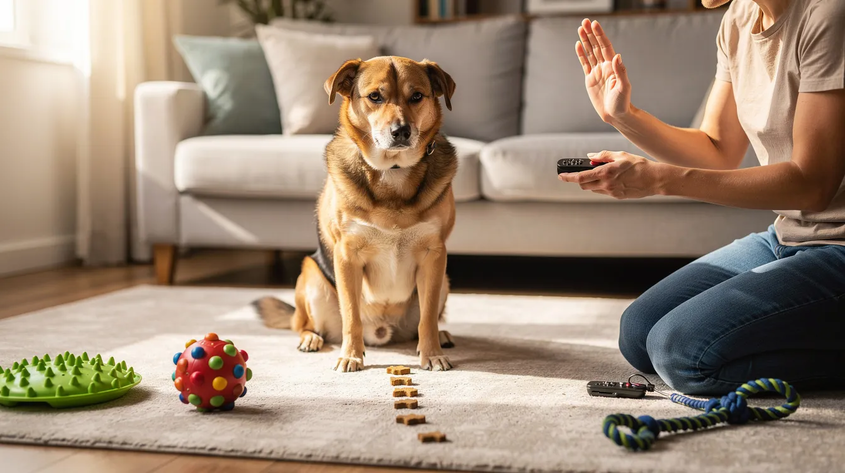
These five games form the foundation of impulse control training for any dog. They require minimal equipment, work in any room of your house, and can be practiced in sessions as short as five minutes. Training sessions that are short and positive are key for teaching impulse control, so resist the urge to marathon these exercises.
Wait for Food Bowl Game
The “Wait for Your Food Dish” game reinforces patience during mealtime-a moment most dogs find almost unbearably exciting. Dogs learn to wait for food by sitting patiently instead of jumping, spinning, or trying to grab the bowl from your hand.
Step-by-step instructions:
- Prepare your dog’s meal and hold the food bowl at chest height. Ask your dog to sit.
- Begin lowering the bowl slowly. The moment your dog breaks the sit, stands up, lunges, or gets impatient, lift the bowl back to chest height without saying anything.
- Wait for the dog to sit again, then resume lowering. Hold the food bowl high to teach waiting behavior.
- When you can place the bowl on the ground with the dog staying in position, use your release cue (“Okay” or “Free”) to let the dog eat.
- Reward dogs for remaining calm during food preparation by making the meal itself the reward.
Progression: Start with tiny waits of one to two seconds. Gradually extend the wait time and add distractions-taking a step back, turning your head, or putting the bowl on the floor and standing up before releasing. Most dogs begin to understand the pattern within three to five sessions.
Common mistakes: Don’t repeat the sit command over and over. Simply lift the bowl when the dog moves and wait. The dog learns that calm behavior makes the bowl descend, while impatient behavior makes it disappear.
Basic Leave It Game
The “Leave It” game teaches dogs to ignore distractions for rewards. This is one of the most important safety behaviors you can teach-it can prevent dogs from eating dangerous items off the ground, from grabbing food off counters, and from lunging at objects on a walk.
The closed-fist method:
- Place a treat in one hand and close your fist. Present the closed fist to your dog.
- Your dog will likely lick, paw, and nose at your hand. Wait without speaking.
- The moment your dog pulls away-even slightly-mark (“Yes!”) and reward with a treat from your other hand. This is critical: the reward comes from a different source than the “left” item.
- Repeat until the dog consistently moves away from the closed fist.
Progression: Move from closed fist to open hand with a treat on your palm. If the dog starts to grab, close your hand. Then progress to treats on the floor with your foot ready to cover them, and finally to treats on the ground without a foot guard. Use a closed fist to train dogs to wait for treats before advancing to more difficult versions.
Safety applications: Once solid indoors, practice on walks. Teaching “leave it” can prevent dogs from eating dangerous items like chicken bones, medication, or toxic plants encountered in the environment.
Door Threshold Training
Threshold training at doors helps dogs learn self-control around exciting situations-and it directly addresses door rushing, one of the most common and dangerous impulse control failures. A dog that bolts through an open door risks traffic, getting lost, or knocking someone over.
Technique:
- Approach a closed door with your dog on leash. Ask for a sit.
- Reach for the doorknob. If the dog breaks position, remove your hand and wait.
- Gradually progress: touch the knob, turn the knob, crack the door open a bit. At each stage, if the dog stays calm, proceed. If the dog moves, close the door and reset.
- When you can open the door fully with the dog staying in a sit, use your release cue to walk through together.
This exercise builds boundary awareness and patience. It connects naturally to the food bowl game and leave it-the dog is learning a consistent principle: calm behavior opens doors (literally), while impulsive behavior closes them. For a deeper understanding of how to proof these skills across different environments, gradual distraction work is essential.
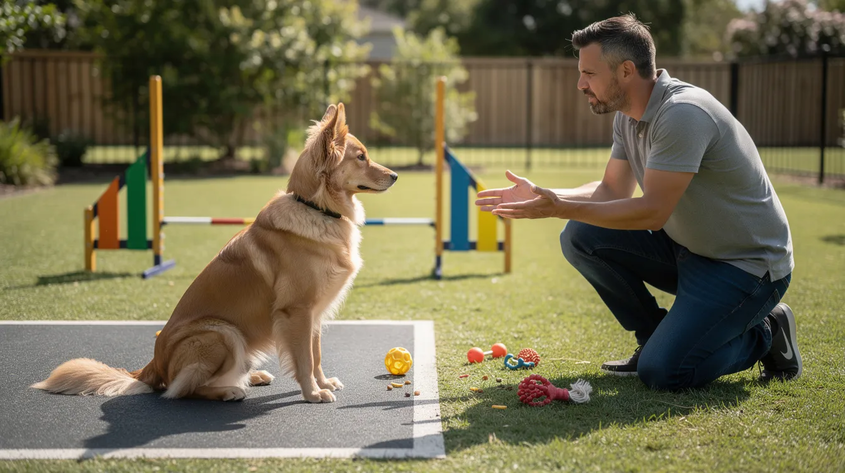
Advanced Impulse Control Games
Once your dog has a solid foundation with basic wait, leave it, and threshold exercises, these advanced games build genuine cognitive resilience. They challenge your dog to maintain self-control in higher-arousal situations and across varied contexts-exactly what research tells us is necessary for lasting improvement.
The “It’s Your Choice” Game
Effective impulse control games include “It’s Your Choice” as a cornerstone exercise. This great game teaches dogs to actively move away from something they want in order to earn it-a profound shift from simply tolerating a wait.
Detailed procedure:
- Hold several treats in a closed fist at your dog’s nose level. Your dog will lick, paw, and mouth at your hand.
- The moment your dog pulls their head back or looks away-even for a moment-mark and reward from that same hand.
- Gradually open your hand, showing the treat on your open hand. If the dog lunges, close your fist. If the dog holds back, mark and reward.
- Progress to placing treats on the floor, on a low table, or in increasingly tempting positions.
Variations: Use different treat values-start with kibble, then upgrade to cheese or chicken. Change hand positions: one hand at knee height, then at ground level, then on a chair. The idea is that the dog learns the principle (resisting earns the reward), not just a specific scenario.
Adapting difficulty: If your dog is struggling, go back to the closed fist for a bit. If your dog consistently holds back with an open hand, progress to dropping treats from the air and rewarding the dog for ignoring them. Dogs learn impulse control through structured training games, and the key is matching difficulty to the dog’s current ability.
Find It Impulse Control Game
Playing “Find It” encourages dogs to wait and search for treats, combining impulse control with mental stimulation. Engaging activities like scent games engage a dog’s cognitive abilities and reduce reactivity, making this a dual-purpose exercise.
Training protocol:
- Ask your dog to sit or lie in a down position. Hold a treat where they can see it.
- Place the treat a few feet away on the ground, then return to your dog.
- Use your release cue, then say “Find it!” Let the dog search.
- Gradually increase hiding difficulty: behind furniture, in another room, under a towel.
Progression: Start with the dog watching you hide the treat. Then begin hiding treats while a helper holds the dog in another room, so the dog must use their nose rather than visual memory. Increase the number of hiding spots and the distance. This exercise is particularly useful outdoors-practice in the yard, then a park, building context generalization.
Benefits: Beyond impulse control, this game satisfies the dog’s natural desire to use their nose, provides genuine mental enrichment, and tires dogs out faster than physical exercise alone. It captures a dog’s attention in a productive way and channels energy into focused searching rather than impulsive reactions.
Flirt Pole Control Exercises
The flirt pole is one of the most powerful tools for teaching impulse control because it works directly with high arousal-exactly where most dogs fall apart. This fun game combines physical exercise with repeated opportunities to practice stop-and-go self-regulation.
Safety guidelines and equipment:
- Use a purpose-built flirt pole with a durable toy attachment. Avoid string or rope that could wrap around legs.
- Play on soft ground (grass, not concrete) to protect joints.
- Avoid this exercise with puppies under six months or dogs with joint issues.
Structured game rules:
- Ask your dog to sit and wait before you begin moving the flirt pole.
- Use “Get it!” as a release cue to let the dog chase and grab the toy.
- After a short burst of play, freeze the pole and ask for a “drop.” Reward the drop with another round of play.
- Periodically ask for a sit or down position between rounds. The dog only gets to play again when four paws are on the ground and they are calm.
DOs and DON’Ts:
- DO keep sessions to five minutes or less to prevent over-arousal
- DO end on a calm moment, not peak excitement
- DON’T let the dog grab the pole handle or your hand
- DON’T play with a dog that cannot stop when asked-go back to foundation games first
Structured play pauses during flirt pole games teach dogs to transition from excitement to calmness, which is the core skill that transfers to real-life situations like encountering another dog on a walk.
Game Comparison and Selection
| Game | Difficulty | Time per Session | Target Behavior | Best For |
| Wait for Food Bowl | Beginner | 2-3 minutes | Mealtime patience | All dogs |
| Leave It | Beginner | 5 minutes | Ignoring distractions | Counter surfing, walk safety |
| Door Threshold | Beginner | 3-5 minutes | Door manners | Door rushers |
| It’s Your Choice | Intermediate | 5-10 minutes | Active self-restraint | Food-motivated dogs |
| Find It | Intermediate | 5-15 minutes | Wait + search | High-energy breeds |
| Flirt Pole Control | Advanced | 5 minutes | Arousal regulation | Prey-driven, high-energy dogs |
| Engage-Disengage | Advanced | 10-15 minutes | Reactivity reduction | Reactive, leash-pulling dogs |
Choosing the right games: For puppies, start exclusively with Wait for Food Bowl, Leave It, and threshold training-keep sessions to two or three minutes and always end on a positive note. Adolescent dogs (four to eighteen months) can begin adding flirt pole work, Find It, and It’s Your Choice. Adult dogs struggling with specific issues like reactivity benefit most from the engage-disengage approach, which teaches dogs to break focus from triggers and disengage automatically.
A 2024 meta-analysis reviewing over 10,000 records across 13 studies found that across 31 pairs of impulse control tasks, 28 showed no correlation-confirming that impulsivity is more of a situational competency than a stable trait. The practical takeaway: don’t rely on a single game. Build a rotation of exercises that covers different triggers, environments, and arousal levels to create genuine, lasting impulse control. Impulse control games build a dog’s self-restraint and focus most effectively when varied across contexts.
Common Training Challenges and Solutions
Even with the best games, every dog owner encounters obstacles. Here are the most common challenges and how to move past them.
Multi-Dog Household Management
Training impulse control when multiple dogs compete for attention and treats requires careful management. The biggest mistake is trying to train all dogs simultaneously before any of them has individual mastery.
Strategies: Train each dog separately in a quiet room first. Use baby gates or crates to keep other dogs out of the training area. Once each dog has solid individual skills, begin practicing with one dog working while another is in a down position nearby. Gradually decrease the distance. This teaches each dog that another dog receiving a treat does not mean they should break position-a powerful real-world skill. Setting a calm environment before giving rewards enhances learning for impulse control, and separating dogs initially is the simplest way to achieve that calm.
High-Energy or Reactive Dogs
Dogs that become overstimulated during training-barking, spinning, unable to listen-need modified approaches. Impulse control helps dogs behave better in various situations, but only if the training itself doesn’t push them past their threshold.
Modified approaches: Start with the dog at a lower arousal baseline. A short walk or brief fetch session before training can take the edge off without exhausting the dog. Use lower-value treats initially to avoid triggering food frenzy. If a dog cannot hold a sit for even one second, don’t ask for a sit-reward four paws on the ground and standing calmly. Build from there. For dogs with serious reactivity or aggression concerns, working with a professional dog trainer ensures safety and proper progression. Practicing impulse control can prevent behaviors like jumping, stealing food, and barking when the approach is calibrated to the individual dog.
Slow Progress or Regression Issues
It’s normal for dogs to seem to “forget” previously learned skills, especially when the environment changes or arousal increases. This isn’t stubbornness-it’s the context-specific nature of impulse control at work.
Troubleshooting: When progress stalls, drop back to an easier version of the game. If your dog was holding a wait with the food bowl on the floor but suddenly can’t, go back to knee height. Make the exercise easy enough that the dog succeeds eight out of ten times, then build back up. Ensure every family member uses the same cues, the same release cue, and the same rules. Inconsistency across people is the most common cause of regression. Games can teach dogs that patience leads to rewards, but only when the rules are applied consistently by everyone the dog interacts with.
Additionally, consider that the Bucket Game helps dogs opt in to handling and grooming-if your dog is struggling with impulse control around being touched or restrained, this specialized game lets the dog choose to participate, reducing stress and building cooperative behavior.
Conclusion and Next Steps
Impulse control games transform impulsive, reactive dogs into calmer companions who think before acting. The research is clear: improvement requires variety across games, consistency in daily practice, and deliberate context generalization-training in the house, the yard, the car, and on walks. Dogs learn impulse control through structured training games, and the more contexts you cover, the more reliable the behavior becomes.
Start here:
- Pick one basic game-Wait for Food Bowl or Leave It-and practice it for five minutes daily this week
- Once your dog succeeds reliably at home, add a second game and begin practicing the first one in a new environment
- After two to three weeks, introduce one advanced game and begin rotating exercises
- Track progress: note which situations still trigger impulsive behavior and target those specifically
For pet parents who want faster results or have dogs with significant behavior challenges, working with a professional dog trainer accelerates the process. Off Leash K9 Training Toledo offers private training sessions and board-and-train programs designed to build distraction-proof obedience across every environment your dog encounters. Our trainers specialize in taking these foundational games and systematically proofing them until your dog responds reliably no matter the distraction.
Related topics worth exploring include teaching the place command for extended calm behavior and advanced recall training for off-leash reliability.
Additional Resources
Equipment recommendations:
- A quality flirt pole with a detachable toy (look for 36-inch poles for medium dogs, 48-inch for large breeds)
- High-value training treats: small, soft, and quick to eat (freeze-dried liver, cheese cubes, or commercial training treats)
- Puzzle feeders and snuffle mats for daily mental stimulation and patience building
Suggested training schedules:
- Puppies (under 4 months): Two to three sessions daily, two to three minutes each. Focus on Wait for Food Bowl, basic Leave It, and simple threshold work. Keep everything low-stress and encouraging.
- Adolescents (4-18 months): Two sessions daily, five to ten minutes each. Rotate through basic and intermediate games. Begin adding distractions and practicing in new locations.
- Adults with behavior problems: One to two focused sessions daily, five to fifteen minutes. Combine foundational games with context-specific drills targeting the specific problem behavior. Seek professional guidance if aggression, severe reactivity, or safety concerns are involved.
Effective impulse control games include “It’s Your Choice” and “Red Light, Green Light” as complementary exercises-Red Light, Green Light being particularly useful for dogs who need to learn to freeze mid-motion during play or on a walk. Combined with the games in this guide, these exercises build a comprehensive impulse control toolkit that serves your dog for life.