Introduction
Mental stimulation is the practice of engaging your dog’s brain through structured cognitive challenges-and it’s every bit as essential as physical exercise for a healthy, well-balanced companion. While most owners understand that dogs need daily walks and playtime, far fewer recognize that a tired brain is as important as a tired body. Without adequate mental exercise, even the most physically active dogs can develop unwanted behaviors rooted in boredom, frustration, and anxiety.
This guide covers everything you need to provide mental stimulation across indoor and outdoor settings, including DIY activities using common household items, commercial puzzle toys and interactive toys, scent work, training-based enrichment, and structured programs tailored to your dog’s age, breed, and energy level. Whether you’re managing a destructive chewer, a reactive walker, or a senior pup showing cognitive slowdown, you’ll find practical solutions here.
The core answer: Mental stimulation involves activities that challenge your dog’s brain through problem-solving, scent work, and learning new tricks and commands. Engaging a dog’s brain is as crucial as physical exercise-just 15 minutes of intense mental work can tire a dog out effectively, often more so than a long run.
Here’s what you’ll take away from this guide:
- How mental stimulation reduces destructive behavior like chewing, digging, and excessive barking
- Why brain games improve focus, impulse control, and obedience under distractions
- Activities that strengthen the bond between you and your dog
- How to keep your dog calm, well-behaved, and mentally sharp at every life stage
- The science behind mental enrichment and cognitive health in senior dogs
Understanding Mental Stimulation Fundamentals
Mental stimulation is cognitive exercise that engages your dog’s natural instincts-sniffing, searching, problem-solving, and decision-making. Unlike physical exercise, which targets muscles and cardiovascular fitness, mental exercise builds neural pathways, sharpens adaptability, and directly addresses the root causes of anxiety and boredom. Dogs need mental exercise alongside physical exercise to thrive, and neglecting the cognitive side is one of the most common reasons furry friends develop behavioral problems.
The relevance is straightforward: providing mental stimulation keeps a dog calm and well-behaved. Research from Texas A&M University found that over 99% of U.S. dogs exhibit at least one behavior problem, with separation anxiety, fear, and aggression among the most common. Many of these issues are exacerbated-or outright caused-by a lack of cognitive engagement.
Why Dogs Need Mental Exercise
Dogs descend from working and hunting ancestors. Herding breeds, retrievers, terriers, and guard dogs were all bred for jobs that demanded sustained mental focus. Today, most dogs spend their days in a house with little to do. That mismatch between instinct and environment creates problems.
When you don’t keep your dog mentally stimulated, the result is predictable: destructive behavior surfaces. Excessive barking, chewing furniture, digging in the yard, and shredding toilet paper rolls are all common signs that a dog’s brain isn’t getting enough work. Dogs enjoy having purposeful tasks or jobs to do, and without them, they’ll invent their own-usually at your expense.
This applies across every life stage. Puppies are building neural pathways rapidly during their first 16 weeks-early mental stimulation helps build confidence and reduces fearfulness later. Adult dogs need ongoing cognitive challenges to maintain focus and impulse control. And for senior dogs, mental stimulation can slow the progression of cognitive dysfunction-a critical consideration given that 28% of dogs aged 11–12 years show cognitive dysfunction, 48% of dogs aged 14 years experience it, and a striking 68% of dogs aged 16 years are affected.
Signs Your Dog Needs More Mental Stimulation
Recognizing when your dog needs more mental enrichment is the first step toward fixing it. Watch for these behavioral indicators:
- Restlessness and pacing – inability to settle down even after physical exercise
- Destructive chewing – targeting furniture, shoes, or household items
- Excessive barking – especially when alone or during quiet time
- Attention-seeking behavior – constant jumping, pawing, or nudging
- Hyperactivity – a dog that seems “wired” no matter how much you walk them
- Poor impulse control – lunging on leash, reactivity toward other dogs
Mental exercises can tire dogs more than physical exercise alone. A mentally fatigued dog settles faster, reacts less, and focuses better during training. Studies on environmental enrichment in working and shelter dogs confirm that cognitive engagement significantly increases relaxation behaviors while decreasing stress and alertness.
Once you recognize these signs, the next step is matching the right type of mental stimulation to your dog’s needs-and there are more options than most owners realize.
Types of Mental Stimulation Activities
Building on the fundamentals, mental stimulation activities fall into three main categories: food-based, environmental enrichment, and training-based. Each engages different cognitive processes, and the most effective approach combines all three to keep your dog engaged across multiple dimensions.
Food-Based Mental Stimulation
One of the simplest ways to provide mental stimulation is to make your dog work for their food. Puzzle toys can turn mealtime into a problem-solving activity, transforming a 30-second inhale into 15–20 minutes of focused mental work.
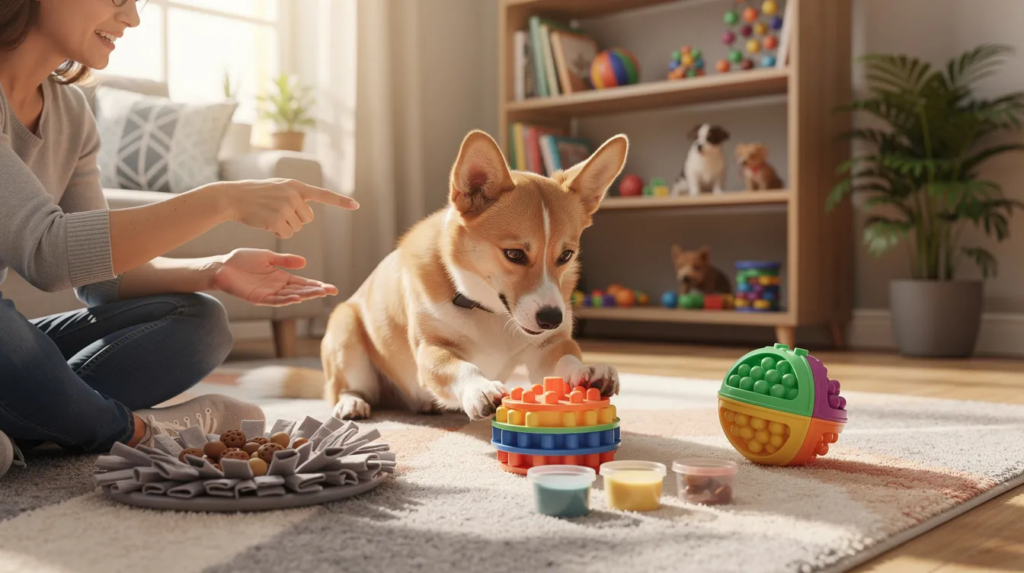
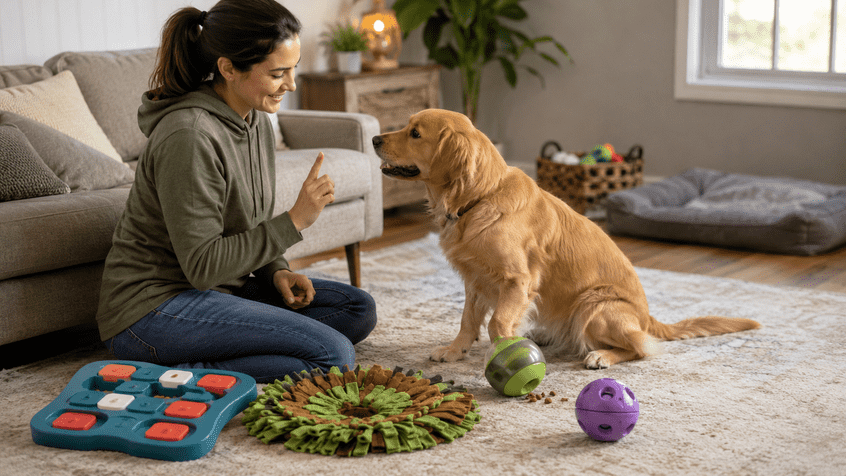
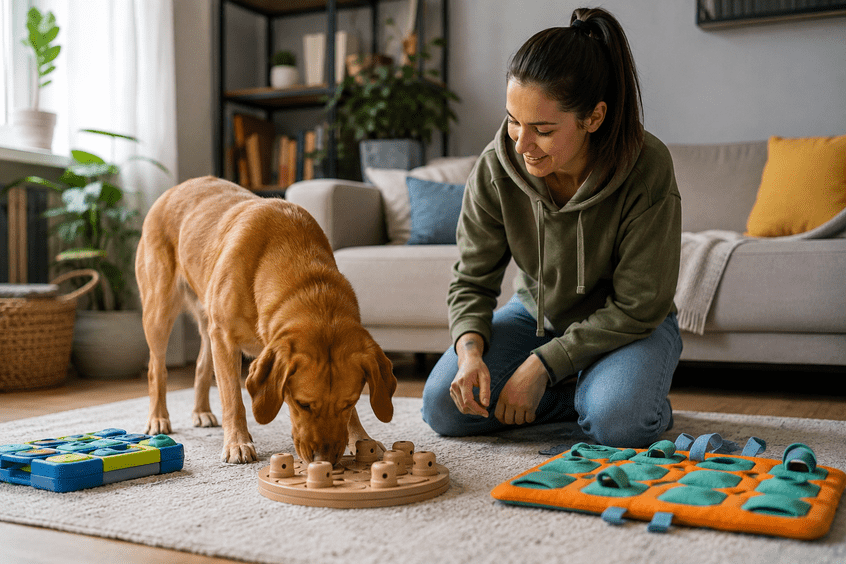
Puzzle feeders and food puzzles come in varying degrees of complexity-from basic treat-dispensing toys that reward dogs for playing with them to multi-step sliding puzzles that require sequenced actions. Kong toys can be filled with food for mental stimulation, and frozen treats provide an extra challenge while dogs lick to eat. Snuffle mats can turn an ordinary meal into an enrichment session by mimicking natural foraging.
Scatter feeding is another powerful and free option: simply hide kibble around the house or yard and let your dog’s nose do the work. Scatter feeding hides food around the house for dogs to find, engaging their strongest sense. You can also hide treats around a room to engage a dog’s sense of smell, or create DIY dig boxes where you hide kibble for dogs to find.
For fast eaters, slow feeders and lick mats serve double duty-they calm dogs while they enjoy their food and prevent digestive issues from gulping. Any activity where a dog must work to access food inside a toy or puzzle taps into instincts that most dogs find deeply satisfying.
Environmental Enrichment
Environmental enrichment goes beyond food to engage your dog’s senses through novel experiences, exploration, and sensory variety. Introducing safe novelty can provide cognitive stimulation for dogs that no amount of repetitive routine can match.
Scent work and nose work are among the most powerful forms of mental stimulation available. Sniffing provides substantial mental engagement for dogs-their olfactory system is their dominant sense, and letting dogs sniff on walks enriches their experience dramatically. Scent walks allow dogs to explore and sniff their environment at their own pace, providing significant mental stimulation during an activity you’re already doing daily.
Novelty and exploration matter enormously. Change your walking routes regularly. Introduce new surfaces, textures, and sounds. Rearrange puzzle toys or play hide-and-seek indoors- playing hide-and-seek engages a dog’s critical thinking skills while building recall and confidence. Even simple changes to the home environment, like a new cardboard box to investigate or a flirt pole session in the backyard, create cognitive engagement.
Indoor options include hiding treats in boxes, rotating toys to maintain novelty, and using scent discrimination games. Outdoor options include varied terrain walks, long-line exploration sessions, and structured sniff walks where you let your pup lead with their nose.
Training-Based Mental Stimulation
Training is one of the most underappreciated forms of brain games. Every time your dog learns a new command, practices obedience under distractions, or masters new tricks, they’re doing intensive cognitive work. Training can be as tiring as physical exercise for dogs-training sessions can mentally exhaust dogs in just 5–15 minutes.
Short training sessions are excellent brain workouts for dogs. Teaching new tricks provides mental stimulation while also strengthening the bond between a dog and its owner. Dogs enjoy learning rules and commands through training, and the process builds confidence in uncertain situations. Even practicing a reliable sit in a new environment counts as serious mental exercise.
For dogs with behavioral challenges-reactivity, leash pulling, aggression-distraction-proof obedience training is both mental stimulation and behavior modification in one. This is where Off Leash K9 Training Toledo’s expertise becomes invaluable: building impulse control and focus under real-world distractions requires systematic cognitive challenge that goes well beyond basic commands.
All three categories-food-based, environmental, and training-based-work together synergistically. A dog that does nose work, eats from food puzzles, and practices obedience training daily is getting comprehensive mental health support that no single activity can match.
Implementing a Mental Stimulation Program
With a clear understanding of activity types, the next step is building a structured program that fits your life and your dog’s needs. Daily mental games can keep a dog happy and focused, but consistency and progression matter more than any single session.
Step-by-Step Implementation Process
A systematic approach produces the best results-especially for owners dealing with established behavioral issues.
- Assess your dog’s current stimulation level and behavioral needs. Consider your dog’s age, breed traits, energy level, and specific issues (reactivity, chewing, anxiety). Factor in how many hours they spend alone and what resources are available in your environment.
- Start with 10–15 minutes of mental activities daily. Begin with a few games that match your dog’s interest-a 5-minute scent game, a 5-minute puzzle feeder session, and 5 minutes of basic training. Training sessions can last 5–15 minutes daily without overwhelming your pup, and training sessions can mentally exhaust senior dogs in 5–15 minutes.
- Gradually increase duration and complexity as your dog adapts. When your dog starts solving a puzzle quickly, upgrade the difficulty. Add distractions to training sessions. Introduce multi-step scent trails instead of simple hide-the-treat games. New challenges prevent boredom and keep cognitive growth progressing.
- Rotate activities weekly to maintain interest and challenge. Rotating interactive toys keeps dogs engaged and curious. Novelty drives cognitive engagement-if you use the same puzzle toy every day, habituation reduces its effectiveness. Cycle through different food puzzles, vary your walking routes, and alternate between trick training and obedience drills.
- Monitor behavioral changes and adjust the program accordingly. Track whether destructive behavior decreases, whether focus improves during walks, and whether your dog settles more easily at home. If a dog starts losing interest, increase the challenge. If they seem frustrated or overwhelmed, scale back.
Activity Comparison Guide
Use this table to choose appropriate activities based on your situation:
| Activity Type | Time Required | Skill Level | Best For |
| Puzzle toys (basic) | 10–15 min | Beginner | Food-motivated dogs, fast eaters |
| Scatter feeding / snuffle mat | 10–15 min | Beginner | All dogs, easy daily enrichment |
| Sniff walk / scent trail | 15–30 min | Beginner–Intermediate | Dogs who love to sniff, indoor dogs |
| Hide and seek (owner hides) | 10 min | Intermediate | Bonding, confidence, recall |
| Trick training / playing games | 5–15 min | Beginner–Advanced | Bonding, fun, mental exercise |
| Advanced obedience (distractions) | 20–30 min | Advanced | High-energy dogs, reactivity, leash issues |
| Frozen treats / Kong stuffing | 15–30 min | Beginner | Anxiety reduction, quiet time, crate training |
| Flirt pole / agility training | 10–20 min | Intermediate | High-drive dogs, great fun outlet |
Most dogs benefit from at least two different activity types per day. You don’t need expensive equipment-many of the most effective options use food you’re already feeding and household items you already own.
The real challenge isn’t knowing what to do-it’s sticking with it when life gets busy. Here’s how to handle the most common obstacles.
Common Challenges and Solutions
Every owner runs into roadblocks when implementing a mental stimulation program. Here are the most frequent problems and how to solve them.
My Dog Loses Interest Quickly
This is almost always a novelty or difficulty problem. Rotate toys and activities weekly-dogs play differently with something they haven’t seen in a few days. If your dog solves a puzzle in under a minute, increase the difficulty by using harder puzzle toys, hiding food in more challenging locations, or adding a tasty treat to high-value hiding spots that require more effort to reach. Puzzle toys have varying degrees of complexity for dogs, so progress through levels rather than staying at the same one.
I Don’t Have Time for Daily Mental Stimulation
You don’t need extra time-you need to repurpose time you’re already spending. Use feeding time for mental stimulation: swap the food bowl for a snuffle mat, scatter feed in the yard, or stuff a Kong. That’s 10–15 minutes of enrichment built into a routine you can’t skip. Add a quick 5-minute training session before meals using positive reinforcement, and let your dog sniff freely during walks instead of rushing through them. These small changes help prevent boredom without adding anything to your schedule. Daily mental games don’t require hours-they require intention.
My Dog Is Too Energetic/Destructive Despite Mental Activities
When mental stimulation alone isn’t enough to curb destructive and unwanted behaviors, the issue usually involves impulse control deficits that require structured professional training. Combine your enrichment program with private training sessions focused on impulse control, or consider a board-and-train program for intensive behavior modification. Dogs with reactivity, aggression, or severe anxiety need both cognitive enrichment and systematic behavior work to see lasting improvement. Interactive toys challenge dogs’ problem-solving abilities, but they can’t replace the relationship-based learning that professional training provides.
Providing mental stimulation is not a one-time fix-it’s an ongoing commitment that pays compounding dividends in your dog’s behavior, health, and quality of life.
Conclusion and Next Steps
Mental stimulation reduces behavioral problems, creates calmer and more focused dogs, and supports cognitive health across every life stage. Providing mental stimulation keeps a dog calm and well-behaved-not through exhaustion, but through genuine cognitive satisfaction. Dogs that work their brains regularly are less reactive, less destructive, and more engaged with their owners. For senior dogs especially, ongoing mental enrichment can slow the progression of cognitive dysfunction that affects such a large percentage of aging pets.
Start here:
- Today: Choose one 10-minute activity-a puzzle feeder at mealtime, a scent game with hidden treats, or a short training session teaching a new trick
- This week: Add a second activity type so your dog gets variety across food-based, environmental, and training categories
- This month: Build a rotating schedule of 3–4 different activities and track behavioral improvements-less chewing, better focus on walks, calmer settling at home
If your dog’s behavioral issues persist despite consistent mental enrichment, or if you’re dealing with aggression, severe reactivity, or separation anxiety, professional training can bridge the gap between enrichment and lasting behavioral change. Game-based learning approaches combine mental stimulation with structured training for dogs that need both. For puppies, early training programs set the foundation for a lifetime of cognitive health and good behavior.
Additional Resources
For behavioral consultations and distraction-proof obedience programs, contact Off Leash K9 Training Toledo, specializing in fast, guaranteed results for dogs of all breeds, ages, and behavioral challenges.
Recommended puzzle toy brands: Nina Ottosson (multi-level puzzles), Trixie (strategy games), Kong (stuffable toys), and snuffle mats for daily feeding enrichment.
DIY mental stimulation ideas: Muffin tin puzzles (place treats in cups, cover with tennis balls), cardboard box scent mazes, toilet paper roll treat holders, frozen Kongs with layered food, and indoor hide-and-seek sessions using your dog’s favorite high-value treats.
For dogs needing intensive behavioral modification, Off Leash K9 Training Toledo’s board and train programs combine mental stimulation, structured obedience, and behavior modification in an immersive environment designed to produce reliable, real-world results.