Introduction
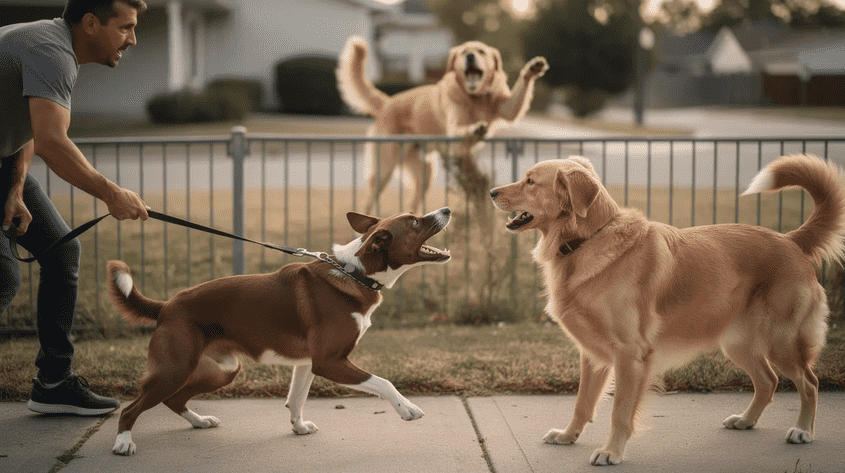
Redirected aggression occurs when a dog cannot access its target-whether that’s another animal behind a fence, a person walking past a window, or even an object just out of reach-and instead channels its aggressive response onto the nearest target available. This could be a family member, another pet, or even an object within striking distance. It is one of the most misunderstood forms of canine aggression because the victim of the bite or lunge often has nothing to do with what originally triggered the dog.
This guide covers identification, prevention, and management strategies for dog owners dealing with redirected aggression episodes. It is written for owners whose dogs show reactive or aggressive behaviors-particularly those considering professional behavior modification-and provides the scientific context, practical safety protocols, and training strategies needed to address the problem effectively. Understanding this behavior matters because redirected aggression is a rapid, impulsive reaction that can cause serious injuries to people and other animals, often without the clear buildup owners expect from other types of aggression in dogs.
Direct answer: Redirected aggression happens when a highly aroused or frustrated dog redirects their aggressive response from an inaccessible trigger to the nearest person, dog, or object within reach. Frustration is a common driver of redirected aggression, and it accounts for roughly 5% of aggression cases seen in veterinary behavior settings.
After reading this guide, you will be able to:
- Recognize the warning signs and body language that precede redirected aggression episodes
- Understand the specific triggers and scenarios that provoke redirection
- Implement environmental prevention strategies to reduce exposure and manage risk
- Respond safely during active episodes without escalating the situation
- Determine when professional help is needed and what effective treatment looks like
Understanding Redirected Aggression in Dogs
Redirected aggression is a displacement behavior that occurs during high arousal states when a dog’s access to its original stimulus is physically blocked. The dog perceives a trigger-another dog on the far side of a fence, a squirrel visible through a window, a stranger walking past while the dog is leashed-and becomes intensely frustrated or excited. Unable to direct its energy toward that trigger, the dog redirects onto whatever person or animal is closest. Critically, the redirected target is incidental, not the cause of the dog’s emotional state.
This is what makes redirected aggression so confusing for owners. A dog may be barking furiously at a passing cyclist, and the moment an owner reaches for the leash or another household dog wanders too close, the dog snaps. To the owner, it feels sudden, unprovoked, and personal. It is none of those things. Understanding triggers is vital for effective dog behavior management, and recognizing that the redirected target is not the intended target is the first step toward addressing the problem constructively.
How Redirected Aggression Differs from Other Types
Redirected aggression is frequently confused with other forms of canine aggression, but the distinctions matter for both safety and treatment.
Fear aggression occurs when a dog feels cornered or trapped and lashes out defensively against a perceived threat. Fearful dogs direct their aggression toward the source of their fear. Territorial aggression is directed at intruders in a dog’s space-a delivery person, a visiting dog-and the target is specific and deliberate. Possessive aggression involves guarding resources from others, whether food, toys, or resting spots. In each of these cases, the aggression is aimed at the entity the dog has a problem with.
With redirected aggression, the target is whoever happens to be nearby when the dog’s arousal level overflows. The dog doesn’t have a problem with that person or animal-they simply couldn’t reach the thing they did have a problem with. This distinction in target selection has major implications for how you manage and treat the behavior. Protective aggression and defensive aggression share emotional arousal with redirection but differ in motivation and target consistency.
The Role of Arousal and Frustration
The engine driving redirected aggression is physiological arousal-a surge of stress hormones, elevated cortisol, sympathetic nervous system activation, and reduced impulse control. Research published in Frontiers in Veterinary Science found that aggressive dogs show measurable increases in facial temperature, drops in serotonin levels, and altered heart rate variability during reactivity tests compared to non-aggressive dogs. These aren’t abstract concepts; they represent a dog whose body is chemically primed for action with nowhere to direct it.
Frustration-elicited aggression happens when a dog is held back-by a leash, a fence, a closed door-from something it desperately wants to reach. That intense frustration creates an overflow of energy, and the dog redirects onto whatever is accessible. Barrier frustration can trigger redirected aggression in dogs even when the dog has no history of aggression toward the redirected target. The higher the dog’s arousal level, the less capacity the dog has for impulse control, and the more likely it is that arousal spills over into an aggressive response toward an unintended target.
Understanding this arousal-frustration connection is essential because it reveals the specific scenarios most likely to produce redirected episodes.

Common Triggers and Scenarios for Redirected Aggression
With the arousal mechanism established, the practical question becomes: where and when does this actually happen? Redirected aggression occurs in predictable patterns once you understand the common setups that combine high arousal with blocked access.
Barrier Frustration Incidents
Barrier frustration is one of the most common drivers of redirected aggression. Window reactivity is a classic scenario-a dog spots another dog, a mail carrier, or a neighbor walking past, and barks intensely at the glass. When a family member approaches to intervene or simply walks through the room, the dog, still in a heightened state, snaps. The person wasn’t the trigger; they were just the closest available target.
Leash reactivity creates identical dynamics. Common triggers include barriers like fences or leashes that prevent a dog from reaching other dogs or stimuli. A dog lunging at the end of a leash toward another dog across the street can redirect onto the owner’s hand, arm, or leg when physically blocked. Redirected aggression can occur when a dog is restrained, and leash situations are among the most frequent contexts reported by owners.
Fence-line aggression follows the same pattern. Two dogs running along opposite sides of a fence, barking and escalating, can reach extreme arousal levels. When one dog can’t get through, it may redirect onto a companion dog on its own side or an owner who approaches. The original trigger was the dog on the other side; the redirected target just happened to be closer.
Multi-Dog Household Triggers
Homes with multiple dogs face elevated risk. During play sessions, arousal can escalate rapidly-what starts as normal roughhousing between two dogs can push one dog past its threshold. If that overly excited dog is interrupted or corrected, it may redirect onto a nearby pet or person who wasn’t involved in the play at all.
Competition over resources-food, toys, preferred resting spots-can generate the frustration that leads to redirection toward uninvolved dogs or other pets in the household. One dog frustrated by another dog guarding a toy may redirect onto a third, uninvolved dog simply because it’s within reach.
Physical intervention during aggressive episodes can lead to redirected bites. This is critically important: owners who physically intervene in dog fights-grabbing collars, pushing between combatting animals-frequently become targets of redirected aggression. The dog’s arousal and aggression remain at peak levels, and the intervening person becomes the nearest target. This is one of the most common ways people are bitten by their own dogs.
Environmental Stressors
Not all triggers are visible. Loud noises-thunderstorms, fireworks, construction-can elevate a dog’s baseline arousal to the point where even minor additional stimuli provoke an aggressive response. Pain or illness can lower a dog’s aggression threshold significantly. A dog managing chronic discomfort from dental disease, joint pain, or neurological conditions may have a substantially reduced tolerance for frustration.
The concept of trigger stacking is critical here. Multiple stressors accumulating over hours or days-a veterinary visit in the morning, unfamiliar visitors in the afternoon, a thunderstorm that evening-progressively lower the threshold for redirection. A dog that normally tolerates barrier frustration without incident may redirect after a day of compounding stress. Even unfamiliar scents from wildlife or other animals can invisibly raise arousal, making seemingly random episodes more predictable once the full picture is understood.
Recognizing these environmental patterns leads directly to the question of how to spot an episode before it erupts.
Recognizing Warning Signs and Safe Response Strategies
The difference between a manageable situation and a bite incident often comes down to seconds. Recognizing early warning signs can help intervene before peak arousal, and having a clear response protocol prevents escalation.
Physical Warning Signs and Body Language
Warning signals typically appear in the seconds before redirection, though many dogs suppress obvious signs until arousal is very high. Learning to read body language is essential for any owner managing aggressive behaviors.
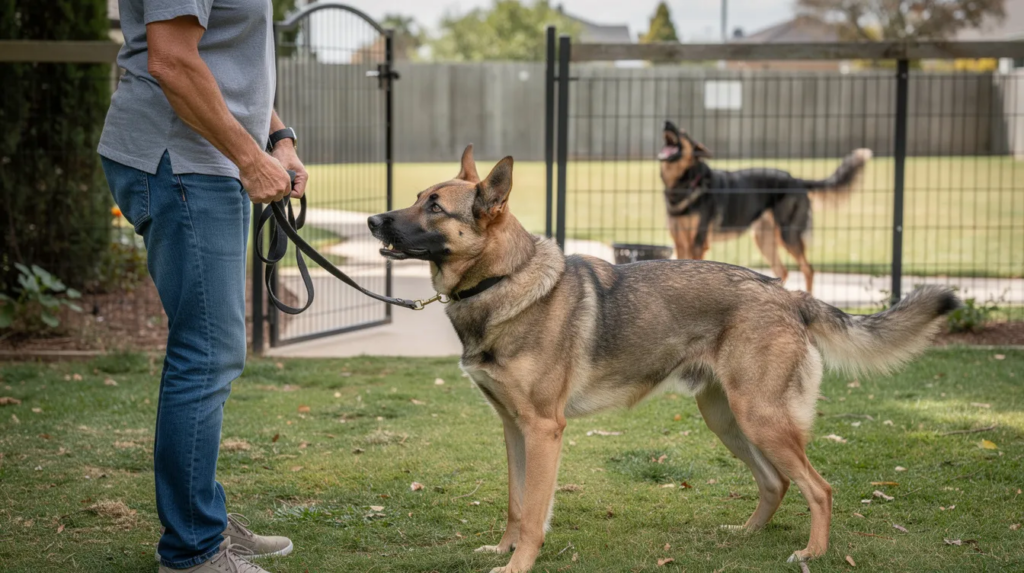
- Stiff body posture and hard staring: Dogs may display stiff body posture and hard staring before aggression occurs. A dog fixated rigidly on a trigger, with locked muscles and an unblinking gaze, is approaching threshold.
- Raised hackles and offensive postures: Piloerection along the spine and shoulders, combined with forward weight distribution, signals active arousal rather than passive observation.
- Arousal may escalate due to barking, stiffening, or intense fixation: The progression from alert watching to barking to lunging follows a recognizable pattern. Intense focus on an inaccessible target-with no response to the owner’s voice-indicates dangerously high arousal.
- Rapid breathing, panting, and restless movement: Pacing, whining, or trembling from overwhelming frustration or excitement are signs the dog’s arousal level is nearing overflow. Displacement behaviors like lip licking, yawning, or paw lifting may also appear.
These signals give you a narrow window to act. The goal is intervening during the buildup rather than after the dog redirects.
Immediate Safety Response Protocol
When you recognize a dog approaching threshold or already in a highly aroused state, implement these steps:
- Create distance immediately without physical contact. Avoid grabbing collars during high-arousal situations-this is one of the fastest ways to become the target of a redirected bite. Instead, move away and encourage the dog to follow using your voice or movement.
- Block visual access to triggers. Close curtains, step between the dog and the window, move behind a parked car on a walk. Removing the visual stimulus often begins de-escalation. On walks, turn and walk in the opposite direction.
- Use commands like “leave it” to redirect focus from triggers. Calm verbal cues the dog already knows-“leave it,” “this way,” the “place” command-can interrupt the arousal cycle if delivered before the dog reaches peak intensity.
- Create safe spaces for dogs to decompress away from triggers. A cooling-off period after stressful events helps reduce a dog’s arousal. Move the dog to a quiet room, a crate they feel comfortable in, or another area removed from stimulation. Allow time for physiological arousal to subside-this can take 20 minutes to several hours depending on the dog and the intensity of the episode.
Never punish a dog during or after a redirected aggression episode. Punishment increases baseline arousal and can make future incidents worse.
Prevention Through Environmental Management
Managing the environment is essential to prevent aggressive incidents with redirects. Prevention is always safer and more effective than reaction.
| Scenario | High-Risk Setup | Low-Risk Management |
| Window reactivity | Unobstructed views of sidewalk, other dogs, foot traffic | Window film, closed blinds during peak hours, dog’s designated “place” away from windows |
| Leash walks | Tight leash, busy routes, unpredictable encounters with other dogs | Harness with front clip, low-traffic routes/times, maintaining distance, structured heel training |
| Fence boundaries | Chain-link or see-through fencing with neighbor dogs visible | Solid privacy fencing, supervised yard time, avoiding simultaneous outdoor access with neighbor dogs |
| Multi-dog mealtimes | Open feeding in shared space with multiple dogs | Separate feeding areas, barriers during meals, supervised resource access |
| Guest arrivals | Dog loose at front door during entries | Dog secured in separate room or crate before guest entry, controlled introductions after arousal settles |
Prevent exposure to known triggers to reduce frustration. Reduce the dog’s exposure to situations that reliably produce high arousal while you work on longer-term behavior modification. This isn’t avoiding the problem-it’s managing the dog’s environment to prevent practice of the unwanted behavior while training progresses.
Desensitization and counter-conditioning are effective methods to change a dog’s emotional response to triggers over time. These techniques involve gradual, controlled exposure to triggers at sub-threshold levels paired with positive reinforcement, systematically helping the dog learn to associate former triggers with calm, positive experiences rather than frustration. Combined with impulse control exercises and proofed obedience under distraction, these methods form the core of effective long-term behavior change.
Common Challenges and Professional Training Solutions
Redirected aggression presents specific challenges that often exceed what owners can manage independently. Here’s where structured professional intervention makes the difference.
Unpredictable Timing and Triggers
Because the original trigger may be partially hidden-a scent, a distant sound, a dog perceives something the owner can’t see-onset can feel completely random. Many dogs also suppress warning signs until arousal is very high, making timing difficult. Professional assessment helps identify trigger patterns that owners miss. A certified behavior consultant or veterinary behaviorist can observe, document, and systematically map a dog’s triggers, then implement desensitization protocols calibrated to the specific dog.
Research supports this approach. A published case study of a 9-month-old Australian Shepherd with early onset aggression-including risk factors of early removal from the dam at 6 weeks, minimal socialization, chronic illness, and aggression in parents-showed that a multimodal treatment plan combining environmental management, positive reinforcement, behavior modification, and pharmacotherapy (fluoxetine and gabapentin) produced measurable improvement within six weeks. By 14 weeks, bite incidents had substantially decreased, and after one year, behavior had stabilized.
Safety Concerns with Multiple Pets
Homes with multiple dogs face compounded risk because redirected aggression may involve uninvolved animals, and managing social interactions across a household during high-arousal moments requires precise timing and structure. Professional help is crucial for managing aggressive behavior in dogs living in multi-pet environments.
Structured training programs teaching impulse control, emergency recall, and reliable obedience commands give owners tools to interrupt arousal cycles before redirection occurs. Professional trainers can create customized treatment plans for aggressive dogs that account for the specific dynamics between animals in the household-which dog is the likely redirector, which are vulnerable targets, and how to structure daily routines to minimize conflict.
Veterinary input is essential for dogs with aggression issues, particularly when medical issues may be contributing. One documented case showed a dog stable on behavior modification for inter-dog aggression until undiagnosed pain from hind limb injury and possible periodontal disease caused a relapse. Introduction of NSAID treatment improved hypervigilance and aggression, underscoring that medical screening must be part of any comprehensive assessment.
Owner Intervention Injuries
Seeking professional help is necessary after a dog bite incident, and many bite injuries from redirected aggression come from owners physically intervening during episodes. Professional assessment is important for dogs displaying serious aggression because trained professionals can teach safe intervention techniques-using sonic cues, visual barriers, or controlled management tools rather than hands. When needed, muzzle conditioning can be incorporated as a short-term safety measure during the behavior modification process, and board-and-train programs provide intensive, supervised environments for dogs that need accelerated intervention.
In mild cases, structured private training sessions may be sufficient. In severe cases-where a person or animal has been injured, where there are neurological conditions or medical issues at play, or where multiple triggers compound the problem-a veterinary behaviorist with the ability to prescribe pharmacotherapy alongside behavior modification provides the most comprehensive path forward.
Conclusion and Next Steps
Redirected aggression in dogs is not a sign of a “bad dog” or unprovoked malice. It is a predictable overflow of frustrated arousal-a dog that cannot reach its target and, in a heightened state, reacts impulsively toward whoever or whatever is closest. With the right techniques-recognizing warning signs early, managing the dog’s environment to prevent exposure to known triggers, building impulse control through structured training, and addressing underlying medical issues-this behavior is manageable and can be significantly reduced.
Take these immediate steps:
- Document your dog’s triggers and warning signs. Keep a log of what the dog was reacting to, what the environment looked like, and what preceded any redirected episode.
- Implement environmental management today. Block visual access to known triggers, adjust walk routes and times, and prevent future incidents by reducing trigger stacking.
- Schedule a professional behavior consultation. A qualified trainer or animal behaviorist can assess your specific situation and build a customized treatment plan incorporating desensitization, counter-conditioning, and impulse control work.
Related topics worth exploring include leash reactivity management, socialization strategies for reactive dogs, and advanced obedience training for distraction-proofing-all of which directly support long-term reduction of redirected aggression risk.
Frequently Asked Questions
What is redirected aggression in dogs and why does it happen suddenly?
Redirected aggression occurs when a dog cannot reach its target-another dog, a person, or even an object-and instead directs its aggressive response onto the nearest available person or animal. It appears sudden because the original trigger may not be visible to the owner, and many dogs suppress warning signs until arousal peaks. The behavior is a rapid, impulsive reaction driven by frustration and high arousal rather than deliberate intent toward the redirected target.
Can any dog show redirected aggression or are certain breeds more prone?
Any dog can exhibit redirected aggression regardless of breed, age, or sex. While research shows that reactivity tendencies and arousal responses have heritable components, a large-sample study of nearly 1,900 reactive dogs found that behavioral pattern and acquisition history were more predictive of escalation risk than breed, age, or whether the dog was a male dog or female dog. Both a younger dog with poor impulse control and an older dog with late-onset behavior changes can develop this pattern.
How do I safely break up a dog fight without becoming a target?
Never physically intervene by grabbing collars, pushing between dogs, or reaching toward the dogs’ heads. Physical intervention during aggressive episodes can lead to redirected bites. Instead, use loud noise (an air horn, banging pots), a visual barrier (a large board, a blanket thrown over one dog), or water to interrupt. Once separated, move each dog to a different enclosed space and allow significant decompression time before reassessing.
When should I seek professional help for redirected aggression episodes?
Professional help is recommended for severe redirected aggression-specifically when any person or animal has been bitten, when episodes are increasing in frequency or intensity, when the dog has multiple or complex triggers, or when an owner feels afraid during incidents. Professional assessment helps identify triggers of redirected aggression that owners may not recognize and ensures that medical issues contributing to lowered thresholds are properly addressed.
What training methods work best for preventing redirected aggression?
The most effective approaches combine environmental management with desensitization and counter-conditioning using positive reinforcement. Impulse control training-commands like “wait,” “leave it,” and emergency recall-practiced under gradually increasing distraction levels helps the dog learn to manage arousal. Preventing exposure to triggers while building these skills is crucial. In severe cases, veterinary-prescribed medication alongside behavior modification produces the strongest outcomes.
How long does behavior modification take for redirected aggression cases?
Timelines vary based on severity, the dog’s history, and owner consistency. Published case studies show measurable improvement beginning within six to eight weeks of structured behavior modification, with significant reduction in aggressive incidents by 14 weeks. Full stabilization can take a year or longer. Behavior modification requires consistent daily work, precise timing, and ongoing management-it is not a one-time fix but a sustained commitment to changing the dog’s behavior and emotional responses over time.